

Introduction
The Qinghai-Tibet Plateau, as a globally significant ecological region, not only harbors a unique biodiversity repository and a gene pool for alpine organisms but also provides essential ecological services, such as regulating nutrient cycles and storing carbon [1]. However, driven by global changes and human interventions, the degradation of alpine grasslands on the Qinghai-Tibet Plateau is widespread [2]. The degradation of these high-altitude grasslands not only leads to biodiversity loss, decreased productivity, soil erosion, and desertification, posing ecological challenges locally, but also contributes to environmental problems downstream in major river basins in Asia [3]. External nitrogen addition is recognized as a crucial measure for grassland restoration, impacting soil’s physical, chemical, and biological characteristics in the short term. This alteration influences plant community structure and functionality, thereby sustaining the stability of grassland ecosystems [4]. Therefore, a better understanding of the effects of nitrogen addition on soil quality is crucial for maintaining sustainable grassland development.
Soil organic carbon and nitrogen storage are fundamental to soil fertility and health [5]. Previous studies have indicated that nitrogen addition can enhance soil nitrogen and carbon storage [6]. However, conflicting research suggests that nitrogen does not affect the accumulation of soil carbon and nitrogen storage [7]. Long-term nitrogen addition has also been linked to the weakening of grassland soil as a carbon-nitrogen reservoir [8]. These discrepancies may be attributed to differences in soil types, vegetation types, and nitrogen addition levels and frequencies, influencing the carbon-nitrogen cycle in grassland ecosystems [9, 10]. The inconsistent findings highlight the need to investigate the response of soil organic carbon and total nitrogen storage to nitrogen addition on the Qinghai-Tibet Plateau’s high-altitude grasslands, with significant implications for the restoration and management of degraded grasslands.
The stability of organic carbon and total nitrogen storage is influenced by both biotic and abiotic factors, including vegetation characteristics and soil physicochemical properties [11]. Generally, higher plant productivity and root surface area signify greater organic carbon and total nitrogen storage [12]. Soil properties control matrix quality and microenvironments, substantially impacting soil carbon and nitrogen storage [13]. Previous studies have often overlooked the integrated exploration of biotic and abiotic factors’ influence on soil carbon and nitrogen storage [14], limiting predictions of biogeochemical cycles in alpine grassland ecosystems.
Therefore, this study aims to elucidate the response of soil organic carbon and total nitrogen storage to nitrogen addition and its driving factors in Qinghai-Tibet Plateau alpine meadow. By combining both biotic and abiotic factors, this research provides new insights into the carbon-nitrogen cycle in high-altitude grasslands, offering scientific support for ecological environmental management and sustainable development in related regions. The main objectives of the study include:
(1) investigating the impact of nitrogen addition on soil carbon and nitrogen storage in high-altitude grasslands on the Qinghai-Tibet Plateau; (2) identifying key biotic and abiotic factors that influence soil organic carbon and total nitrogen storage after nitrogen addition.
Materials and Methods
Study Site
The experiment was conducted at the Three Rivers Source Ecology Observation Station of Qinghai University (33°24′30″N, 97°18′00″E) in Qinghai Province, China. The site is at an altitude of 4270 m and has a typical plateau continental climate, with an average annual temperature of -2.9ºC and an average annual precipitation of 614.1 mm. The grassland is dominated by Kobresia humilis (C. A. Mey. ex Trautv.) Sergiev, and mixed grassland has Kobresia pygmaea Clarke as the main dominant species. Other important species include Stipa aliena Keng. The associated plants include Festuca ovina L. and Elymus nutans Griseb. According to the FAO soil classification system, the soil is classified as a Cambisol. The soil texture ranges from sandy loam to sandy soil from shallow to deep layers. Before nitrogen addition, the soil had a pH value of 6.92, organic matter content of 2.36%, available N content of 14.0 mg/kg, available P content of 7.0 mg/kg, and available K content of 76.5 mg/kg.
Experimental Design
The experiment was conducted in a fenced homogeneous natural grassland. In May 2020, 15 plots measuring 4 × 3 m were established with a 1 m buffer zone between adjacent plots and at the edges of the plots to minimize interference. Based on previous studies by De et al. [15] on alpine grasslands in the Sanjiangyuan region, the optimal nitrogen addition rate for grassland productivity was 30 g N/m2. Therefore, in the present study, five levels of nitrogen addition were implemented: 0 (CK), 15 g N/m2 (N15, low nitrogen), 30 g N/m2 (N30, moderate nitrogen), and 60 g N/m2 (N60, high nitrogen). Urea (total N≥46.4%, Yuntianhua Group, Yunnan, China) was used as the nitrogen source, and a randomized complete block design with three replicates was applied for each treatment, randomly arranged. Urea dissolved in 1 L of distilled water was evenly sprayed onto the experimental plots, while the control plots (CK) were sprayed with an equal amount of water.
Vegetation Sampling and Analysis
Sampling was carried out in the trial area from August 2020 to 2022. Sampling was repeated three times using a sample method with a sampling area of 0.50 m × 0.50 m. For each quadrat, the height, number, and biomass of each species were recorded, along with the relative biomass of plant functional groups (grass, sedge, forb), total aboveground biomass, and belowground biomass. The aboveground biomass (AGB) of all plant community components in each quadrat was harvested, dried in an oven at 70°C for 48 hours, and weighed. Additionally, three soil cores (diameter 4 cm, depth 30 cm) were randomly collected in each quadrat. The collected soil samples were sieved through a 2 mm sieve, and the roots were cleaned and dried in an oven at 70°C for 48 hours to determine the belowground biomass (BGB) of each plant.
The Importance Value (IV) of a species, which signifies its dominance within a community, was computed as the mean of the sum of Relative Height (RH), Relative Coverage (RC), and Relative Frequency (RF). The Importance Value for Forbs (VForbs), Importance Value for Grasses (VGrasses), and Importance Value for Sedges (VSedges) were determined using the formula as follows [16]:
Species richness (S) was calculated using the number of species in each quadrat, and the Margalef richness index (R), Shannon-Wiener diversity index (H), and Pielou evenness index (E) of the vegetation community were calculated using the formulas [17]:
Margalef richness index (R):
R = (S − 1)/ln(n)
Shannon -Wiener diversity index (H):
Pielou evenness index (E):
E = H/ln(S)
Where S represents the total species number in the quadrat, n is the total number of individuals of all species in the quadrat, and Pi is the proportion of the number of individuals belonging to its total number of the community.
Soil Sampling and Analysis
Soil bulk density was sampled using a bulk density ring (diameter 70 mm, depth 50 mm) and then dried at 105ºC for 48 hours to obtain dry weight. Composite soil samples were prepared from five samples collected from the topsoil (30 cm depth) using a soil auger (diameter 2 cm) and sieved through a 2 mm sieve. Soil parameters, including Soil Total Nitrogen (STN), Soil Ammonium Nitrogen (SAN), Soil Nitrate Nitrogen (SNN), and Soil Available Nitrogen (SAVN), were analyzed using various methods. Soil Organic Carbon (SOC) was determined through potassium dichromate oxidation and external heating (Shi et al. 2011). SOC storage (SOCS) and STN storage (SNS) were calculated as per Zhang et al. [18]:
SOC storage = SOC × BD × D
SNS storage = STN×BD×D where BD is the soil bulk density (g/cm3); and D is the soil depth (cm) of 30 cm.
Data Analysis
Analysis of variance (ANOVA) and LSD multiple comparisons (P<0.05) were used to assess the impact of nitrogen addition on soil physicochemical properties, plant community characteristics, and soil carbon and nitrogen storage. Pearson correlation analysis was employed to analyze the relationships between soil carbon and nitrogen storage, soil physicochemical properties, and plant community. Redundancy analysis in Canoco 5.0 (Microcomputer Power, USA) was used to evaluate the combined effects of plant and soil variables on soil carbon and nitrogen storage. Stepwise multiple linear regression was used to analyze the relationship between plant and soil factors and soil organic carbon and total nitrogen storage. Structural equation modeling (SEM) was applied in AMOS 23.0 (IBM, USA) to reveal the direct and indirect effects of plant and soil factors on soil carbon and nitrogen storage. Model performance indicators, including the ratio of chi-square to degrees of freedom (less than 3 is good), p-values (greater than 0.05 is good), comparative fit index (CFI, greater than 0.9 is good), and standardized root mean square residual (SRMR, less than 0.1 is acceptable), were used to describe the model’s performance [19].
Results
Plant Community Characteristics, Soil Physicochemical Properties, and Soil Carbon and Nitrogen Storage
Analysis of variance indicated a noteworthy impact of nitrogen addition on various ecological parameters, including aboveground biomass (AGB), belowground biomass (BGB), Margalef richness index (R), Shannon-Wiener diversity index (H), Pielou evenness index (E), Important value of Forbs (VForbs), and Important value of Grasses (VGrasses) (p<0.05). Particularly, Margalef richness index (R), Shannon-Wiener index (H), and Important value of Grasses (VGrasses) exhibited a gradual decrease with increasing nitrogen addition levels. In contrast, aboveground biomass (AGB), belowground biomass (BGB), and Important value of Forbs (VForbs) demonstrated a gradual increase with escalating nitrogen addition levels (Table 1).
Nitrogen addition significantly influenced Soil Total Nitrogen (STN), Soil Ammonium Nitrogen (SAN), Soil Nitrate Nitrogen (SNN), Soil Available Nitrogen (SAVN), Soil Organic Carbon (SOC), and Soil bulk density (BD) (p<0.001). Among these, Soil Total Nitrogen (STN), Soil Ammonium Nitrogen (SAN), Soil Nitrate Nitrogen (SNN), Soil Available Nitrogen (SAVN), and Soil Organic Carbon (SOC) exhibited an increasing trend with the rise in nitrogen addition, while Soil bulk density (BD) demonstrated a decreasing trend with increasing nitrogen levels (Table 1).
Table 1.
Plant community characteristics, soil physicochemical properties and soil carbon and nitrogen storage under each treatment.
[i] Note: The value of each processing is Mean±SE. Lower-case letters indicate differences between treatments (LSD, p< 0.05). STN, soil total nitrogen (g/kg); SAN, soil ammonium nitrogen (mg/kg); SNN, soil nitrate nitrogen (mg/kg); SAVN, soil available nitrogen (mg/kg); SOC, soil organic carbon (g/kg); BD, soil bulk density (g/cm3); SOCS, soil carbon storage (kg/m2); SNS, soil nitrogen storage (kg/m2); AGB, plant aboveground biomass (g/m2); BGB, plant underground biomass (g/m2); E, plant evenness index; R, species richness; H, diversity index; VForbs, important value of gramineae; VSedges, important value of Sedge;VGrasses, important value of miscellaneous grass.
Nitrogen addition significantly boosted SOC storage (SOCS) and STN storage (SNS) (p<0.001). In comparison to the control (CK), SOC storage (SOCS) increased by 1.22, 1.32, and 1.59 times under N15, N30, and N60 treatments, respectively, while STN storage (SNS) increased by 1.5, 1.9, and 2.4 times, respectively (Table 1).
Relationships between Soil Physicochemical Properties, Plant Community Characteristics, and Soil Carbon and Nitrogen Storage
Under nitrogen addition, distinct relationships were observed among soil organic carbon and nitrogen storage, soil physicochemical properties, and plant community characteristics (Fig. 1). Specifically, soil organic carbon storage exhibited significant positive correlations with AGB, BGB, VForbs, STN, SAN, SNN, SAVN, and SOC (with R2 values of 0.78, 0.56, 0.48, 0.76, 0.48, 0.5, 0.91, and 0.94, respectively), while showing significant negative correlations with BD, E, R, H (with R2 values of 0.7, 0.56, 0.78, and 0.66, respectively).
Furthermore, soil nitrogen storage demonstrated significant positive correlations with STN, SAN, SNN, SAVN, SOC, AGB, BGB, and VForbs (with R2 values of 0.98, 0.72, 0.92, 0.76, 0.86, 0.92, 0.56, and 0.75, respectively), while displaying significant negative correlations with BD, E, R, H, VSedges, and VGrasses (with R2 values of 0.86, 0.57, 0.79, 0.44, 0.48, and 0.78, respectively).
Factors Associated with Soil Carbon and Nitrogen Storage
The results of the RDA analysis indicate that changes in SOCS (soil organic carbon storage) and SNS (soil total nitrogen storage) within the 0-30 cm soil layer are explained by RDA1 and RDA2 axes, accounting for 95.74% and 2.28% of the explained variance, respectively (Fig. 2). The Stepwise Multiple Linear Regression results reveal that environmental factors account for 97.0% of the variation in SOCS and 98.0% of the variation in SNS (Table 2).
Concerning the variation in SOCS, the primary explanatory factors include SOC, BD, SNN, and VGrasses. On the other hand, the variation in SNS is significantly influenced by STN, VForbs, BD, SAVN, and BGB.
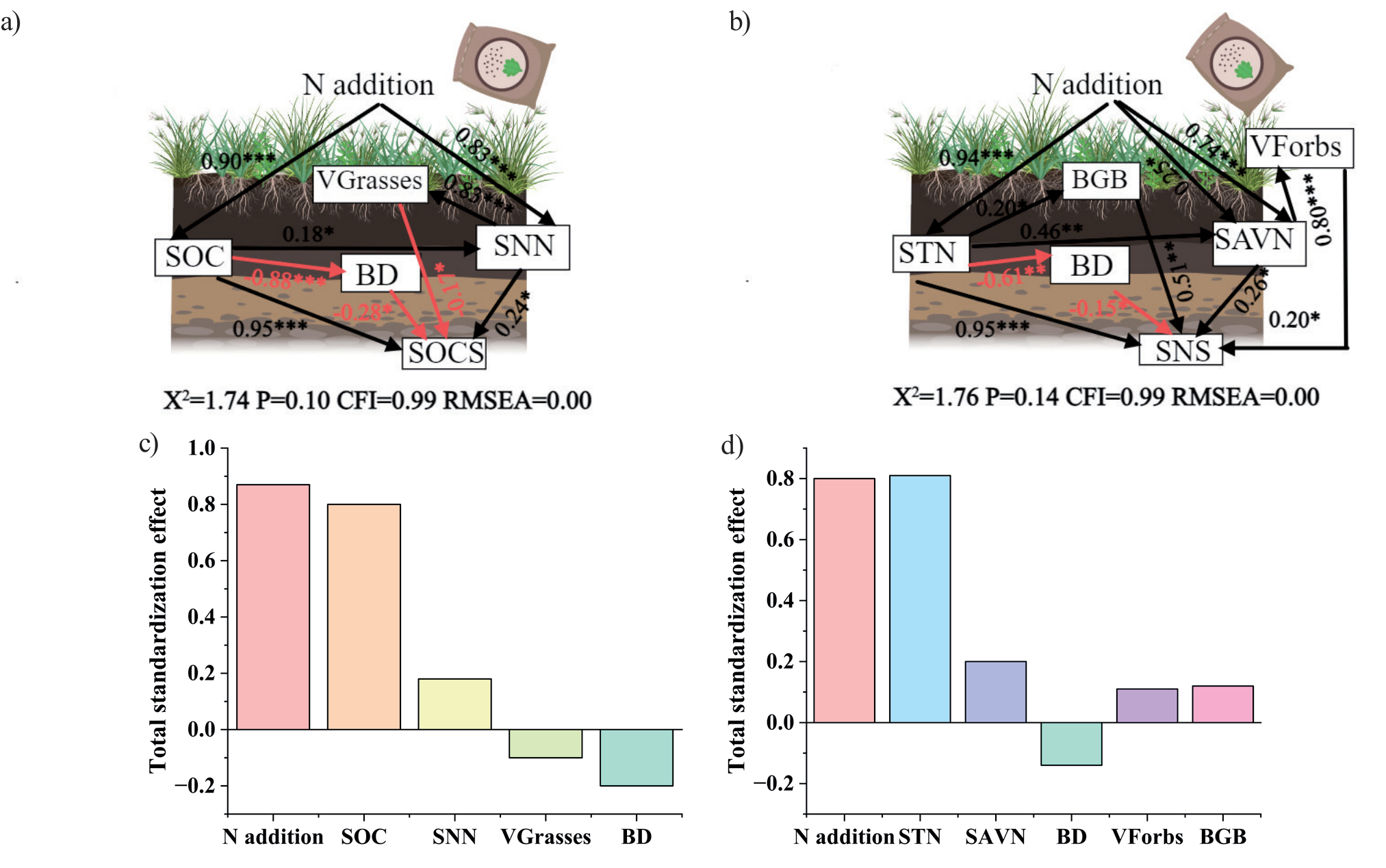
The SEM model illustrates that key factors explain 99% of the variation in both SOCS (Fig. 3a) and SNS (Fig. 3b). Under nitrogen addition, SOCS is positively affected by SOC and SNN while being negatively influenced by VGrasses and BD (Fig. 3a). For SNS, STN, VForbs, SAVN, and BGB have significant positive effects, while BD has a significant negative effect (Fig. 3b). Furthermore, the total standardized effects of N addition, SOC, SNN, VGrasses, and BD on SOCS are 0.87, 0.80, 0.18, -0.10, -0.20, respectively (Fig. 3c), and for SNS, the total standardized effects of N addition, STN, VForbs, BD, SAVN, and BGB are 0.80, 0.81, 0.20, -0.14, 0.11, 0.12, respectively (Fig. 3d).
Fig. 1.
Correlation analysis of soil physicochemical properties, plant community characteristics and soil carbon and nitrogen storage under nitrogen addition.
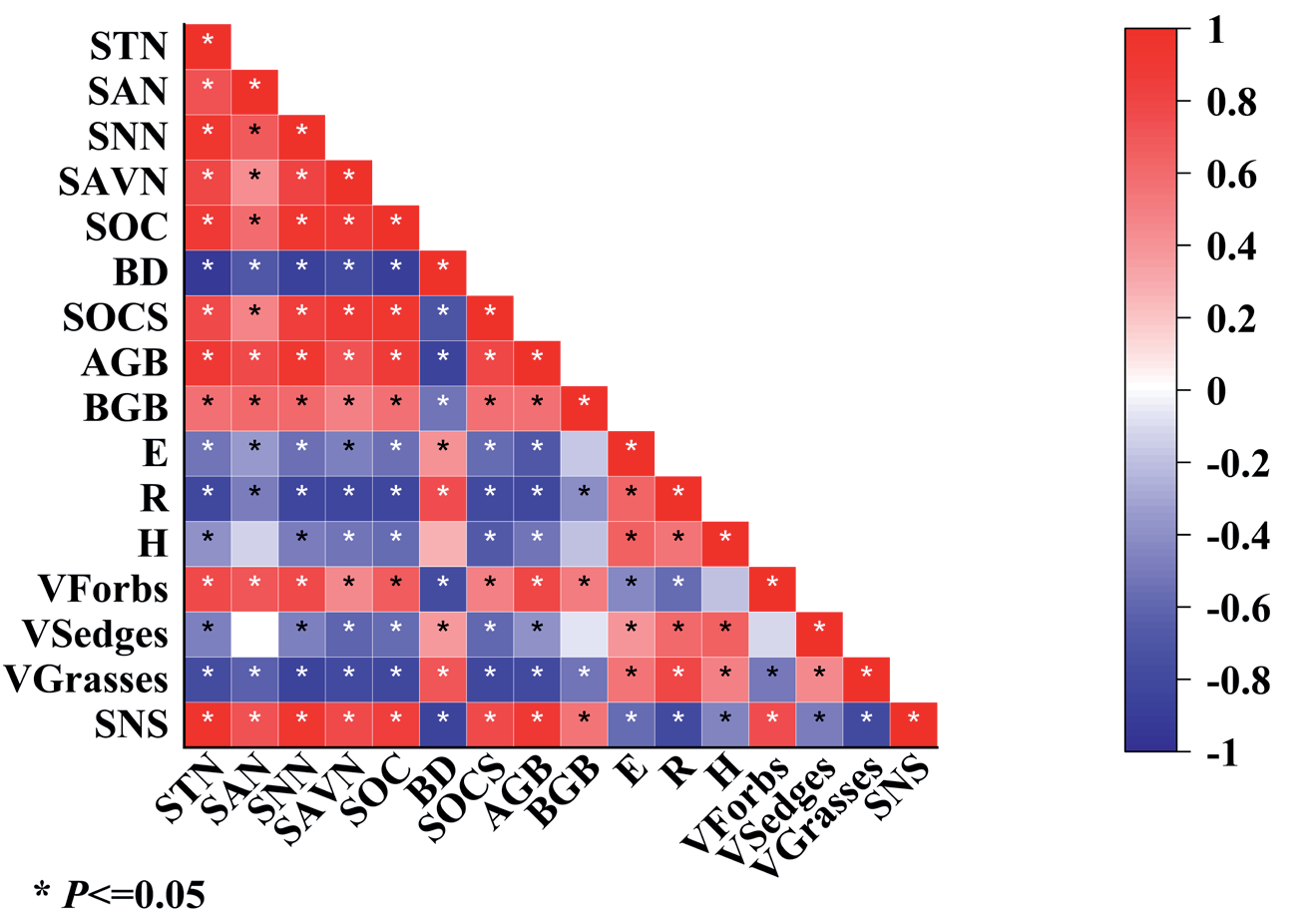
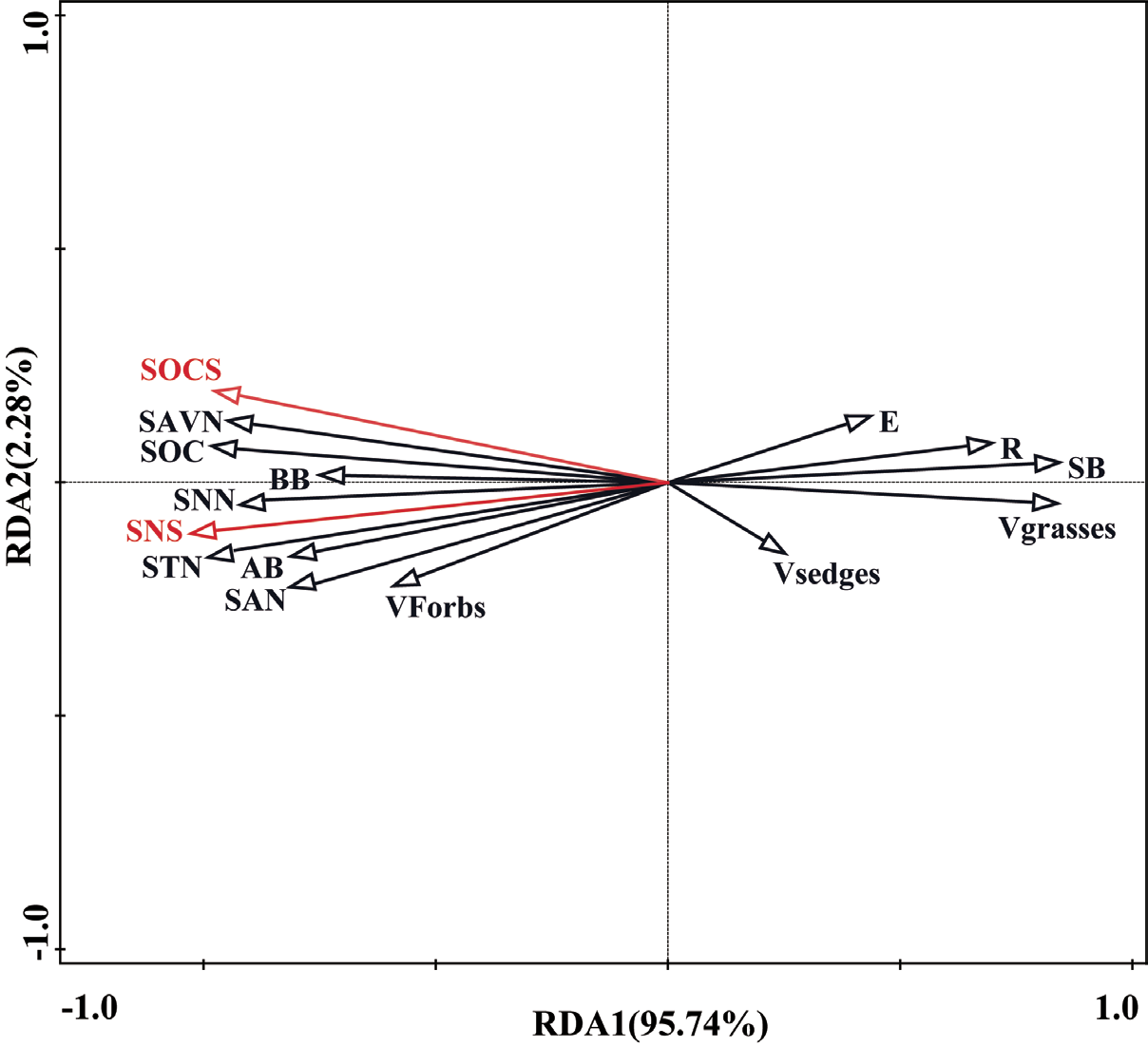
Table 2.
Stepwise multiple linear regression analysis of plant and soil factors and soil organic carbon and total nitrogen storage.
| Stepwise multiple linear regression equation | R2 | P |
|---|---|---|
| Y1 = 0.128+0.13SOC+0.02SNN-1.21BD-0.05VGrasses | 0.97 | <0.001 |
| Y2 = 0.03+0.23STN+0.04VForbs+0.08SAVN+0.18BGB-0.08BD | 0.98 | <0.001 |
[i] Note: Y1 and Y2 indicate SOC storage (kg/m2) and TN storage (kg/m2) respectively. SOC, soil organic carbon content (g/kg); TN, total nitrogen content (g/kg); SNN, soil nitrate nitrogen content (mg/kg), SAVN, soil available nitrogen content (mg/kg), BGB, plant subsurface biomass (g/m2),BD, soil bulk density (g/cm3).
Fig. 3.
Uses structural equation model to study the direct and indirect regulatory pathways of key factors on 0-30 cm soil organic carbon and total nitrogen storage (Created with MedPeer.com) Unidirectional arrows denote pathways, with red and black arrows indicating positive and negative correlations, respectively. Numbers on paths are standardized regression weights, with “*”, “**”, and “***” denoting path significance at p<0.05, p<0.01 and p<0.001 levels.
Discussion
Impact of Nitrogen Addition on Plant and Soil Characteristics
This study observed a gradual decline in species richness and diversity indices with increasing nitrogen addition levels, consistent with findings in Inner Mongolia and semi-arid steppe studies [20, 21]. The results suggest that a reduction in diversity is one of the most common effects of nitrogen increase on grassland ecosystems. The study indicates an increasing trend in the importance value of Poaceae and a decreasing trend in the importance value of miscellaneous grasses with rising nitrogen addition levels. This is primarily attributed to nitrogen addition promoting community turnover by favoring nitrogen-loving plant species with rapid growth, intensifying competition among subordinate species for limited resources (such as light, phosphorus, and water) [22, 23]. Consequently, plant species’ response to nitrogen addition may result in a negative impact on plant diversity. The reasons for the influence of nitrogen addition on the plant community structure in alpine grasslands are discussed below: 1) Increased nutrient availability diminishes the ecological niche dimensions of plant communities, leading to increased competition among species for other limited resources, such as light, promoting the random extinction of low-abundance species [24]. For instance, under nitrogen-rich conditions, the rapid growth of dominant perennial grasses exacerbates light limitations for rare secondary grasses, promoting their exclusion from the plant community [25]; 2) Differences in adaptive abilities among plants and disparities in resource acquisition and storage strategies result in varying inter-species competitiveness, increasing the dominance of Poaceae plants and reducing the dominance of rare grasses [26, 27].
This study found that both aboveground and belowground biomass exhibited a gradual increase with higher nitrogen addition levels. Studies in contrasting steppes [28] and meadow steppes [29] have also indicated that nitrogen fertilization significantly enhances grassland productivity. This is attributed to increased nitrogen availability in the soil, making it easier for plants to absorb and utilize these nutrients [30]. Additionally, the increase in nitrogen application directly influences root traits and mycorrhizae, indirectly increasing the effectiveness of soil nutrients and subsequently boosting both aboveground and belowground biomass [31].
Furthermore, this study observed an increasing trend in soil total nitrogen, soil ammonium nitrogen, soil available nitrogen, and soil nitrate nitrogen with rising nitrogen addition levels. Similar studies in desert grasslands and alpine meadows have shown that nitrogen addition significantly increases soil available nitrogen and total nitrogen content [32, 33]. Nitrogen application directly elevates the mineral nitrogen content in the soil and litter layer, promoting soil nitrogen mineralization and nitrification, thereby increasing available nitrogen [34]. The study also found a positive correlation between soil organic carbon content and nitrogen addition levels. Previous research has indicated that nitrogen deposition can significantly increase organic carbon content [35]. However, conflicting findings suggest that nitrogen deposition may inhibit [36] or have no effect on organic carbon content [37]. This discrepancy is mainly due to the input of external nitrogen promoting litter decomposition, resulting in soil carbon loss [38]. Moreover, the study observed a decreasing trend in soil bulk density with increasing nitrogen addition levels. A study in the Mediterranean grassland ecosystem also found that nitrogen fertilization decreases soil bulk density and increases soil porosity [39]. This is attributed to nitrogen addition altering soil structural characteristics, thereby reducing soil penetration resistance [40].
Impact of Nitrogen Addition on Soil Organic Carbon Storage
This study revealed a significant increase in soil carbon storage with nitrogen addition. Research suggests that nitrogen deposition can enhance total soil carbon storage by reducing the decomposition of plant litter and soil organic matter [41]. The reasons for the increase in soil organic carbon storage due to nitrogen addition are as follows: 1) The rise in nitrogen promotes the metabolic activity of plant roots and increases aboveground biomass [42]. This results in a greater input of organic matter (roots, litter, and other organic substances) into the soil, which decomposes and transforms into soil carbon, consequently augmenting soil carbon storage [43]. 2) Nitrogen addition influences soil organic carbon decomposition through its impact on soil physicochemical properties [44].
The study found that high plant diversity leads to increased deep-root biomass in the soil profile, promoting the accumulation of soil carbon storage [45]. Besides plant species richness, specific plant functional groups and their composition in the plant community are considered major factors affecting the organic carbon content in the soil [46]. In this study, it was observed that the importance value of miscellaneous grasses under nitrogen addition was negatively correlated with soil carbon storage. This is attributed to the deeper root systems of tall Poaceae plants compared to those of miscellaneous grasses, resulting in less carbon storage in the 0-30 cm soil depth [47]. The study also confirmed that the decrease in soil organic carbon content leads to an increase in soil bulk density [48]. This is because nitrogen addition stimulates the growth and reproduction of plant roots, making them more likely to penetrate deeper soil layers, increasing soil porosity and significantly reducing soil bulk density.
Furthermore, the study found that under nitrogen addition, soil organic carbon and nitrate nitrogen had a significant positive impact on soil carbon storage. A similar positive effect of soil nitrogen on organic carbon storage was also observed in alpine shrublands on the Qinghai-Tibet Plateau [49].This is attributed to nitrogen addition increasing nitrogen supply in the soil, stimulating plant growth, leading to more organic matter input into the soil, and consequently influencing soil carbon storage [50].In conclusion, nitrogen addition has a positive impact on soil carbon storage primarily through increasing soil organic carbon, decreasing soil bulk density, and enhancing soil available nitrogen supply. However, competition from miscellaneous grasses may have a negative impact on soil carbon storage, as they could alter vegetation structure and soil ecosystem functions, affecting carbon decomposition.
Impact of Nitrogen Addition on Soil Total Nitrogen Storage
This study found a significant increase in soil nitrogen storage with nitrogen addition, consistent with research indicating that fertilizer input significantly enhances soil total nitrogen storage [51]. This is attributed to nitrogen addition improving soil structure, increasing the proportion of soil macroaggregates, and indirectly enhancing soil nitrogen storage capacity [52].
Changes in vegetation composition can influence the accumulation of soil nitrogen through the decomposition and transformation of aboveground and belowground litter [53]. The study observed a significant positive impact of Poaceae importance value on soil nitrogen storage. This is because Poaceae plants typically possess deep root systems, allowing them to access nitrogen elements in deeper soil layers. When Poaceae plants dominate in vegetation, their root systems contribute to fixing more nitrogen in the soil, thereby increasing soil nitrogen storage [54]. Due to complementary resource utilization, plant diversity often increases the nitrogen fixation of live plants, and the increase in root biomass can contribute to greater nitrogen input into the soil [55]. The study also found a significant positive impact of belowground biomass on soil nitrogen storage. Similar positive correlations between root biomass and soil nitrogen storage were observed in studies conducted in the Three Rivers Source Region’s alpine wetlands and alpine grasslands [56].
Soil physicochemical properties are also crucial factors influencing soil nitrogen storage [57]. This study found that soil total nitrogen and available nitrogen had a significant positive impact on soil nitrogen storage. Nitrogen addition increased plant root biomass, providing more litter and root exudates to the soil, leading to nitrogen accumulation and promoting soil nitrogen storage [58]. The study observed a negative correlation between soil nitrogen storage and soil bulk density, consistent with findings in the Loess Plateau [5]. Soil bulk density is an indicator of soil compaction and aeration, influencing nitrogen decomposition and transformation by affecting microbial activity [59]. Additionally, high soil bulk density can affect root exudate permeation, inhibit plant root growth, and reduce nitrogen input into the soil [60]. Lower soil bulk density is favorable for the storage of soil total nitrogen [61].
In summary, the accumulation of soil nitrogen storage depends on the balance between organic matter input and decomposition. Organic matter input is mainly influenced by plant species and biomass, while decomposition is affected by soil physicochemical properties (bulk density, nutrients). The combined effects of these factors determine soil total nitrogen storage [62].
Conclusion
Nitrogen addition significantly enhances organic carbon and total nitrogen storage in alpine meadow soils. This effect can be primarily attributed to nitrogen’s stimulation of the growth of graminoid plants while suppressing that of forbs. This growth enhancement leads to increased root biomass, subsequently augmenting organic matter input into the soil and facilitating the accumulation of organic carbon and nitrogen. Moreover, nitrogen addition ameliorates soil physicochemical properties, such as elevating soil total nitrogen, available nitrogen, organic carbon, and nitrate nitrogen content, while reducing soil bulk density, which aids in carbon and nitrogen storage. This study holds critical relevance for soil carbon and nitrogen cycling and the conservation of grassland ecosystems. Future research could delve into the impact of nitrogen input on soil biodiversity and microbial activity, contributing to a comprehensive understanding of its ecological implications and the significance of sustainable management.