

Introduction
The synthesis of vitamin E-containing sulfa drug derivatives was reported previously [1]. The functionalization of vitamin E linked to seleno/ heterocyclic derivatives as well as their cytotoxicity effects on the human breast cancer cell line [2] were also demonstrated, revealing that the α-Tocopherol bearing shams_abdelhafez@yahoo.com seleno/nicotine moiety when compared to the other anticancer drugs seleno/pyridine, seleno/pyridazine and seleno/coumarine moieties, has the highest cytotoxic activity. In addition, according to a literature survey, the synthesis of 1,2,3-selenadiazole and 1,2,3-thiadiazole molecules has stimulated the interest of numerous researchers due to their antibacterial and antifungal activities, in addition anticancer activity [3-9]. In consideration of the above-mentioned investigations of vitamin e connected to sulfa drugs as an antibacterial agent1 as well as the effect of vitamin e bearing some seleno heterocyclic compounds [2], we created and evaluated 1,2,3-selenadaizole and 1,2,3-thiadaizole derivatives attached to α-Tocopherol in order to get access to new families of biological active compounds.
Material and Methods
General
Column chromatography was carried out on 0.04- 0.063 mm (Merck) silica gel, thin layer chromatography was carried out on aluminum backed silica plates by Merck and plates were revealed using a UV 254 light. Infrared (KBr, cm−1) spectroscopy was calculated on a Pye-Unicam SP3-100 instrument. 1H NMR spectra were detected at King Abdel-Aziz University using a Varian (400 MHz) EM 390 USA instrument. The peaks of the spectroscopy were recorded as Single (s), Double (d), Triple (t) and Quartet (q). 13C-NMR spectra were recorded at King Abdel- Aziz University, Saudi Arabia, on a JNM – LA spectrometer (100 MHz). Chloroform was used for both 1H and 13C-NMR using TMS. Mass spectra were recorded at the National Research Centre, Cairo , Egypt on a JEOL -JMS-AX 500. On an analyzer (Elementar Vario EL 1150ºC) the elemental analysis was reported.
Compounds 4, 5, 6a-d, 7a-d, 8a-d 9a-d and 10a-d, -(((R)-2,5,7,8-tetramethyl-2-((4R,8R)-4,8,12-tri-
methyltridecyl)chroman-6-yloxy) = (α-tocopheryl) Synthesis of 1-((R)-2,5,7,8-tetramethyl-2-((4R,8R)- 4,8,12-trimethyltridecyl) chroman-6-yloxy)propan-2- one (2).
A mixture of compound 1 (α-tocopherol) (2.15 g, 0.005 mol), chloroacetone (0.41 mL, 0.005 mol) and NaOH (0.20 g, 0.005 mol) in dimethylformamide (20 mL) were stirred for 24 h at room temperature, ethylacetate (25 mL) and brine (10 mL) were added, the aqueous was extracted with ethylacetate (10 mL × 2), the combined ethylacetate was washed with brine (10 mL × 2) and water (10 mL x 1), dried over MgSO4. Then, the solvent was removed, to obtain derivative 2 as colorless oil, 1.57 g, yield, 65%. IR (KBr) νmax 1700 (C=O) cm–1. 1H NMR (Chloroform) δ, ppm: 5.20 (2H, s, OCH2), 2.35 (3H, s, CH3, O=C-CH3), 2.20 (3H, s, CH3), 2.10 (3H, s, CH3), 1.92 (3H, m, 3CH), 1.65 (6H, m, 2CH3), 1.45 (22H, m, 11CH2), 0.97 (12H, m, 4CH3). 13CNMR δ, ppm: 11.6, 12.5, 15.7, 19.5, 20.4, 21.5, 22.5, 22.7, 23.9, 24.5, 24.6, 24.8, 25.9, 27.9, 31.3, 31.5, 32.2, 36.3, 37.5, 38.6, 39.4, 40.1, 70.2, 74.7, 117.5, 123.1, 125.5, 128.3, 129.1, 147.9, 148.1, 206.0 (C, CO). MS m/z (%): 486 [M+-1, 60], Anal. Calcd. for C32H54O3: C, 78.96; H, 11.18. Found C, 78.77; H, 11.00. 2-(1-((R)-2,5,7,8-tetramethyl-2-((4R,8R)-4,8,12- trimethyltridecyl)chroman-6-yloxy) propan-2- ylidene)hydrazinecarboxamide (3).
In ethanol (50 mL) semicarbazide hydrochloride (1.12 g, 0.01 mmol), mixed with sodium acetate (1.23 g, 0.015 mol) was refluxed for 30 min. The precipitated sodium chloride was filtered from the hot solution and derivative (2) (4.86 g, 0.01 mol) was added to the hot solution. The reaction mixture was heated at reflux for a further 2hrs., then diluted with ethylacetate (50 mL) and brine (30 mL), the aqueous was extracted with ethylacetate (15 mL × 2), the combined ethylacetate was washed with brine (20 mL × 2), water (20 mL × 1), dried over MgSO4. After removal of the solvent, the residue was purified by Colum chromatography (hexane/ ethylacetate V/V 10:1) to give pale yellow oil, 3.26 g, yield 60%. IR (KBr) νmax 3400, 3350, 3149 (NH, NH2); 1655 (C=O-amide) cm–1. 1H NMR (Chloroform) δ, ppm: 8.95 (1H, s, NH); 6.01 (2H, s, NH2); 4.20 (2H, s, OCH2), 1.91 (3H, s, CH3), 2.20 (3H, s, CH3), 2.10 (3H, s, CH3), 1.92 (3H, m, 3CH), 1.65 (6H, m, 2CH3), 1.46 (22H, m, 11CH2), 0.95 (12H, m, 4CH3). 13CNMR δ, ppm: 11.9, 12.5, 15.7, 19.4, 20.4, 21.3, 22.7, 22.8, 23.7, 24.4, 24.5, 24.6, 25.9, 27.9, 31.3, 31.5, 32.3, 36.3, 37.5, 38.5, 39.4, 40.2, 70.1, 74.5, 117.7, 123.1, 125.5, 128.4, 129.2, 147.7, 148.2, 155.5, 157.0 (C, CO). MS m/z (%): 544 [M+, 20], Anal. Calcd. for C33H57N3O3: C, 72.88; H, 10.56; N,7.73. Found C, 72.65; H, 10.38; N,7.55 . 4-(α-tocopheryl) methyl)-1,2,3-thiadiazole (4).
Thionyl chloride (5 mL) was stirred at 0ºC and the semicarbazone 3 (5.44 g, 0.01 mol) was added in small portion. The mixture was stirred at room temperature overnight until no more hydrogen chloride was produced. The remaining thionyl chloride was evaporated under vacuum. Methylene chloride (15 mL) was added and the resulting mixture was decomposed with saturated sodium carbonate. The organic layer was washed with water and dried on anhydrous sodium sulfate. The product 4 was purified by column chromatography (hexane/ethylacetate V/V 10:1) to give colorless oil, 2.90 g, yield 60%. IR (KBr) νmax 3073, 2920, 2850, 1463 cm–1. 1H NMR (Chloroform) δ, ppm: 8.15 (1H, s, CH-Thiadiazole), 4.23 (2H, s, OCH2), 2.22 (3H, s, CH3), 2.11 (3H, s, CH3), 1.90 (3H, m, 3CH), 1.65 (6H, m, 2CH3), 1.45 (22H, m, 11CH2), 0.96 (12H, m, 4CH3). 13CNMR δ, ppm: 11.8, 12.6, 15.7, 19.5, 20.5, 21.3, 22.8, 22.9, 23.7, 24.5, 24.6, 24.8, 25.9, 27.9 , 31.3, 31.5, 32.2, 36.3, 37.3, 38.5, 39.1, 40.3, 70.2 , 74.7, 117.5, 123.2, 125.5, 128.1, 132.1, 147.6, 148.1, 155.6. MS m/z (%): 529 [M+-1, 15], Anal. Calcd. for C32H52N2O2S: C, 72.68; H, 9.91; N, 5.30. Found C, 72.61; H, 9.88; N, 5.00. 4-(α-tocopheryl ) methyl)-1,2,3-selenadiazole (5).
Semicarbazone 3 (5.44 g, 0.01mol) was dissolved in glacial acetic acid with vigorous stirring and gentle heating to 70ºC. The solution was treated with selenium dioxide powder (1.66 g, 0.015 mmol, and the mixture was kept under vigorous stirring. After ca. 2 min the color of the mixture becomes red. The reaction was complete in 24 hrs. The mixture was filtered to remove unreacted selenium and the filtrates poured into ice water and extracted with Chloroform (3 × 50 mL). The combined organic layers were washed with saturated sodium hydrogen carbonate solution. dried over magnesium sulphate and the solvent was removed under vacuum to afford the crude compound 5, which was further purified by column chromatography (hexane/ ethylacetate V/V 10:1) to give pale yellow oil compound 5, 2.87 g, yield 50%. IR (KBr) νmax 3073, 2920, 2850, 1463 cm–1. 1H NMR (Chloroform) δ, ppm: 8.50 (1H, s, CH-Selenadiazole), 4.25 (2H, s, OCH2), 2.10 (3H, s, CH3), 1.95 (3H, s, CH3), 1.92 (3H, m, 3CH), 1.65 (6H, m, 2CH3), 1.45 (22H, m, 11CH2), 0.96 (12H, m, 4CH3). 13CNMR δ, ppm: 11.9, 12.6, 15.7, 19.5, 20.5, 21.3, 22.8, 22.9, 23.7, 24.5, 24.8, 24.9, 25.9, 27.9 , 31.3, 31.5, 32.2, 36.3, 37.3, 38.5, 39.1, 40.3, 70.2 , 74.7, 117.5, 123.2, 125.5, 128.1, 132.1, 147.6, 148.1, 155.3. MS m/z (%): 602 [M+ + Na+, isotope Se-patern,10], Anal. Calcd. for C32H52N2O2Se: C, 66.76; H, 9.10; N,4.87. Found C, 66.61; H, 9.88; N, 4.67. 4-(α-tocopheryl) methyl)-1,2,3-telluradiazole (6).
Similarly, TeO2 was used in the prior technique to synthesis 1,2,3-selenadiazole, but the end product was not obtained 6. Synthesis of 1-(4-substitutedphenyl)-2-( α-tocopheryl) ethanone (7a-d).
General Procedure
In dimethylformamide (20 mL), 4-substituted phenacy bromide (4-methoxy;4-nitro-4-fluoro and 4-cyano) (0.005 mol) and NaOH (0.20 g, 0.005 mol) were added to the derivative 1 (2.15 g, 0.005 mol). Mixed compounds were stirred for 24 hrs, at room temperature, then added ethylacetate (30 mL) and brine (20 mL). The aqueous was extracted with ethylacetate (15 mL × 2), the combined ethylacetate was washed with brine (15 mL × 2), water (15 mL × 1), and dried over MgSO4. After that, the solvent was removed and the products obtained without purification as pale yellow oil compounds 7a-d;
7a; 1.73 g, yield, 60 %. IR (KBr) νmax 1685 (C=O) cm–1. 1H NMR (Chloroform) δ, ppm: 7.50, 8.00 (4H, m, Ph-ring) , 4.92 (2H, s, OCH2), 3.95 (3H, s, Ph-OCH3), 2.20 (3H, s, CH3), 2.20 (3H, s, CH3), 1.90 (3H, m, 3CH), 1.65 (6H, m, 2CH3), 1.45 (22H, m, 11CH2 ), 0.97 (12H, m, 4CH3). 13CNMR δ, ppm: 11.8, 12.8, 15.9, 19.7, 20.5, 21.3, 22.6, 22.7, 23.7, 24.5, 24.8, 24.9, 25.9, 27.9, 31.3, 31.5, 32.2, 36.5, 37.5, 38.3, 39.2, 40.2, 55.3, 70.1, 74.9, 113.6, 114.4, 117.7, 123.1, 124.8, 126.4, 128.3, 129.1, 130.6, 147.8, 148.2, 163.9, 193.0 (C, CO). MS m/z (%): 579 [M+, 30], Anal. Calcd. for C38H58O4: C, 78.85; H, 10.10. Found C, 78.80; H, 10.00.
7b; 4.16 g, yield, 70 %. IR (KBr) νmax 1695 (C=O) cm–1. 1H NMR (Chloroform) δ, ppm: 7.25, 8.50 (4H, m, Ph-ring) , 4.95 (2H, s, OCH2), 2.22 (3H, s, CH3), 2.20 (3H, s, CH3), 1.92 (3H, m, 3CH), 1.66 (6H, m, 2CH3), 1.45 (22H, m, 11CH2), 0.96 (12H, m, 4CH3).13CNMR δ, ppm: 11.9, 12.8, 15.9, 19.5, 20.4, 21.3, 22.7, 22.8, 23.7, 24.2, 24.3, 24.7, 25.9, 27.9, 31.3, 31.5, 32.4, 36.6, 37.5, 38.3, 39.2, 40.1, 70.2, 74.9, 113.6, 114.3, 117.6, 123.0, 124.7, 126.3, 128.2, 129.0, 130.7, 147.8, 148.3, 162.4, 171.0 (C, CO).
MS m/z (%): 593 [M+, 20], Anal. Calcd. for C37H55NO5: C, 74.83; H, 9.34; N, 2.36. Found C, 74.82; H, 9.30; N, 2.11.
7c; 3.68 g, yield, 65 %. IR (KBr) νmax 1690 (C=O) cm–1. 1H NMR (Chloroform) δ, ppm: 7.15, 8.20 (4H, m, Ph-ring), 4.75 (2H, s, OCH2), 2.20 (3H, s, CH3), 2.19 (3H, s, CH3), 1.86 (3H, m, 3CH), 1.68 (6H, m, 2CH3), 1.45 (22H, m, 11CH2), 0.95 (12H, m, 4CH3). 13CNMR δ, ppm: 11.8, 12.8, 15.9, 19.5, 20.4, 21.3, 22.7, 22.8, 23.7, 24.2, 24.3, 24.7, 25.9, 27.9, 31.3, 31.5, 32.4, 36.6, 37.5, 38.3, 39.2, 40.1, 70.2, 74.9, 113.6, 114.3, 117.6, 123.0, 124.7, 126.3, 128.2, 129.0, 130.7, 147.8, 148.3, 162.4, 170.0 (C, CO).
MS m/z (%): 567 [M+, 25], Anal. Calcd. for C37H55FO3: C, 78.40; H, 9.78. Found C, 78.22; H, 9.55.
7d; 3.44 g, yield, 60 %. IR (KBr) νmax 2217 (CN); 1690 (C=O) cm–1. 1H NMR (Chloroform) δ, ppm: 7.12, 8.50 (4H, m, Ph-ring), 4.55 (2H, s, OCH2), 2.15 (3H, s, CH3), 2.19 (3H, s, CH3), 1.82 (3H, m, 3CH), 1.65 (6H, m, 2CH3), 1.45 (22H, m, 11CH2), 0.99 (12H, m, 4CH3). 13CNMR δ, ppm: 11.9, 12.8, 15.9, 19.5, 20.4, 21.3, 22.7, 22.8, 23.7, 24.2, 24.3, 24.7, 25.9, 27.9, 31.3, 31.5, 32.4, 36.6, 37.5, 38.3, 39.2, 40.1, 70.2, 74.9, 113.5, 114.3, 116.8, 118.3, 123.0, 124.7, 126.3, 128.2, 129.0, 130.7, 147.8, 148.2, 162.8, 174.0 (C, CO).
MS m/z (%): 573 [M+-1, 30], Anal. Calcd. for C38H55NO3: C, 79.53; H, 9.66; N, 2.44. Found C, 79.52; H, 9.45; N, 2.33. 2-(1-(4-substitutedphenyl)-2-(α-tocopheryl) ethylidene)hydrazinecarboxamide (8a-d)
In ethanol (50 mL) semicarbazide hydrochloride (0.01 mmol), mixed with sodium acetate (0.015 mol) was heated under reflux for 30 min. The precipitated sodium chloride was filtered from the hot solution and derivatives (7a-d) (0.01 mol) were added to the hot solution. The reaction mixture was heated for a further 2hrs., then diluted with ethylacetate (50 mL) and brine (30 mL), the aqueous was extracted with ethyl acetate (15 mL × 2), the combined ethylacetate was washed with brine (20 mL × 2), water (20 mL x 1), dried over MgSO4. After removal of the solvent, the residue was purified by Colum chromatography (hexane/ethylacetate V/V 10:1) to give pale yellow oil compounds (8a-d),
8a; 3.50 g, yield 55 %. IR (KBr) νmax 3400,3350,3149 (NH, NH2); 1665 (C=O-amide) cm–1. 1H NMR (Chloroform) δ, ppm: 9.59 (1H, s, NH); 7.50, 8.00 (4H, m, Phenyl-ring); 6.95 (2H, s, NH2); 3.98 (3H, s, OCH3); 4.20 (2H, s, OCH2), 2.15 (3H, s, CH3), 2.19 (3H, s, CH3), 1.86 (3H, m, 3CH), 1.65 (6H, m, 2CH3), 1.45 (22H, m, 11CH2), 0.97 (12H, m, 4CH3). 13CNMR δ, ppm: 11.9, 12.8, 15.9, 19.5, 20.8, 21.5, 22.7, 22.8, 23.8, 24.4, 24.7, 24.9, 25.9, 27.9, 31.3, 31.5, 32.3, 36.5, 37.6, 38.7, 39.8, 40.2, 55.8, 74.8, 114.5, 114.8, 115.2, 116.3, 117.6, 123.1, 125.8, 128.4, 128.8, 129.0, 147.5, 148.4, 162.5, 155.5, 157.0 (C, CO). MS m/z (%): 635 [M+ -1, 40]. Anal. Calcd. for C39H61N3O4: C, 73.66; H, 9.67.
8b; 3.90 g, yield 60 %. IR (KBr) νmax 3420,3350,3149 (NH, NH2); 1665 (C=O-amide) cm–1. 1H NMR (Chloroform) δ, ppm: 9.59 (1H, s, NH); 7.20, 8.50 (4H, m, Phenyl-ring); 6.95 (2H, s, NH2); 4.50 (2H, s, OCH2), 2.20 (3H, s, CH3), 2.19 (3H, s, CH3), 1.85 (3H, m, 3CH), 1.68 (6H, m, 2CH3), 1.46 (22H, m, 11CH2), 0.97 (12H, m, 4CH3). 13CNMR δ, ppm: 11.8, 12.8, 15.9, 19.4, 20.7, 21.5, 22.6, 22.8, 23.6, 24.4, 24.7, 24.9, 25.9, 27.9, 31.4, 31.5, 32.2, 36.5, 37.5, 38.7, 39.7, 40.1, 74.8, 114.5, 114.8, 115.2, 116.3, 117.6, 123.1, 125.7, 128.5, 128.8, 129.0, 147.5, 148.4, 162.5, 155.5, 158.0 (C, CO). MS m/z (%): 650 [M+ -1, 50], Anal. Calcd. for C38H58N4O5: C, 70.12; H, 8.98; N, 8.61. Found C, 70.00; H, 8.75; N, 8.35.
8c; 3.90 g, yield 60 %. IR (KBr) νmax 3400, 3350, 3149 (NH, NH2); 1655 (C=O-amide) cm–1. 1H NMR (Chloroform) δ, ppm: 9.50 (1H, s, NH); 7.25, 8.00 (4H, m, Phenyl-ring); 6.90 (2H, s, NH2); 4.50 (2H, s, OCH2), 2.19 (3H, s, CH3), 2.07 (3H, s, CH3), 1.86 (3H, m, 3CH), 1.67 (6H, m, 2CH3), 1.46 (22H, m, 11CH2), 0.95 (12H, m, 4CH3). 13CNMR δ, ppm: 11.9 12.8, 15.9, 19.4, 20.7, 21.5, 22.6, 22.8, 23.6, 24.4, 24.7, 24.8, 25.9, 27.9, 31.4, 31.5, 32.2, 36.5, 37.5, 38.7, 39.7, 40.1, 74.8, 114.5, 114.8, 115.2, 116.3, 117.6, 123.1, 125.7, 128.5, 128.8, 129.0, 147.5, 148.4, 162.5, 155.5, 159.0 (C, CO). MS m/z (%): 623 [M+ -1, 10], Anal. Calcd. for C38H58 FN3O3: C, 73.16; H, 9.37; N, 6.74. Found C, 73.10; H, 9.15; N, 6.55.
8d; 3.79 g, yield 60%. IR (KBr) νmax 3400, 3350, 3149 (NH, NH2); 1655 (C=O-amide); 2217 (CN) cm–1. 1H NMR (Chloroform) δ, ppm: 9.59 (1H, s, NH); 7.25, 8.00 (4H, m, Phenyl-ring); 6.95 (2H, s, NH2); 4.50 (2H, s, OCH2), 2.18 (3H, s, CH3), 2.19 (3H, s, CH3), 1.87 (3H, m, 3CH), 1.67 (6H, m, 2CH3), 1.46 (22H, m, 11CH2), 0.95 (12H, m, 4CH3).13CNMR δ, ppm: 11.8, 12.8, 15.9, 19.4, 20.7, 21.5, 22.6, 22.8, 23.7, 24.4, 24.7, 24.8, 25.9, 27.9, 31.4, 31.5, 32.2, 36.5, 37.5, 38.7, 39.7, 40.1, 74.8, 114.5, 114.8, 115.2, 116.3, 117.6, 118.5, 123.1, 125.7, 128.5, 128.8, 129.0, 147.5, 148.4, 162.5, 155.5, 157.8 (C, CO). MS m/z (%): 630 [M+ +1, 20], Anal. Calcd. for C39H58 N4O3: C, 74.25; H, 9.27; N, 8.88. Found C, 74.15; H, 9.10; N, 8.65. 5-(4-substitutedphenyl)-4-(α-tocopheryl) methyl)- 1,2,3-thiadiazole (9a-c).
Thionyl chloride (5 mL) was stirred at 0ºC and the semicarbazone derivatives 8a-d (0.01 mol) was added in small portion. After that the mixture was stirred at room temperature overnight until no more HCl gas was produced. The remaining thionyl chloride was evaporated under vacuum. CH2Cl2 (15 mL) was added and the resulting mixture was decomposed with saturated sodium carbonate. The organic layer was washed with water and dried on anhydrous sodium sulfate. The products 9a-d were purified by column chromatography (hexane/ ethylacetate V/V 10:1) to give pale yellow oil compounds 9a-d;
9a; 2.54 g, yield 40%. IR (KBr) νmax 3073, 2920, 2850, 1463 cm–1. 1H NMR (Chloroform) δ, ppm: 7.00- 8.20 (4H, m, Ph-ring), 4.20 (2H, s, OCH2), 3.95 (3H, s, OCH3), 2.19 (3H, s, CH3), 2.19 (3H, s, CH3), 1.85 (3H, m, 3CH), 1.69 (6H, m, 2CH3), 1.45 (22H, m, 11CH2), 0.90 (12H, m, 4CH3). 13CNMR δ, ppm: 11.9, 12.5, 15.6, 19.5, 20.5, 21.6, 22.7, 22.8, 23.5, 24.5, 24.6, 24.8, 25.9, 27.9, 31.4, 31.6, 32.4, 36.6, 37.7, 38.3, 39.5, 40.1, 55.6, 70.1, 74.3, 114.5, 115.7, 117.6, 123.2, 125.3, 128.4, 128.5, 129.4, 130.8, 132.3, 132.0, 147.5, 148.4, 155.5. MS m/z (%): 634 [M+-1, 25], Anal. Calcd. for C39H58N2O3S: C, 73.77; H, 9.21; N, 4.41. Found C, 73.65; H, 9.00; N, 4.20.
9b; 2.93 g, yield 45 %. IR (KBr) νmax 3073, 2920, 2850, 1463 cm–1. 1H NMR (Chloroform) δ, ppm: 7.00-8.30 (4H, m, Ph-ring), 4.20 (2H, s, OCH2), 2.20 (3H, s, CH3), 2.16 (3H, s, CH3), 1.85 (3H, m, 3CH), 1.65 (6H, m, 2CH3), 1.46 (22H, m, 11CH2), 0.95 (12H, m, 4CH3). 13CNMR δ, ppm: 11.9, 12.5, 15.9, 19.5, 20.5, 21.5, 22.8, 22.9, 23.5, 24.3, 24.6, 24.8, 25.9, 27.9, 31.4, 31.5, 32.2, 36.6, 37.6, 38.3, 39.5, 40.2, 70.1, 74.2, 114.5, 115.7, 117.6, 123.2, 125.5, 128.4, 128.5, 129.4, 130.8, 132.3, 132.0, 147.8, 148.2, 156.5. MS m/z (%): 649 [M+-1, 15], Anal. Calcd. for C38H55N3O4S: C, 70.22; H, 8.53; N, 6.47. Found C, 70.15; H, 8.40; N, 6.27.
9c; 2.49 g, yield 40 %. IR (KBr) νmax 3073, 2920, 2850, 1463 cm–1. 1H NMR (Chloroform) δ, ppm: 7.00-8.50 (4H, m, Ph-ring), 4.50 (2H, s, OCH2), 2.20 (3H, s, CH3), 2.15 (3H, s, CH3), 1.85 (3H, m, 3CH), 1.65(6H, m, 2CH3), 1.44 (22H, m, 11CH2), 0.95 (12H, m, 4CH3). 13CNMR δ, ppm: 11.6, 12.5, 15.9, 19.5, 20.5, 21.5, 22.8, 22.9, 23.5, 24.3, 24.6, 24.8, 25.9, 27.9, 31.4, 31.5, 32.2, 36.6, 37.6, 38.3, 39.5, 40.2, 70.1, 74.2, 114.5, 115.7, 117.6, 123.2, 125.5, 128.4, 128.5, 129.4, 130.8, 132.3, 132.0, 147.8, 148.2, 154.5. MS m/z (%): 622 [M+-1, 10], Anal. Calcd. for C38H55FN2O2S: C, 73.27; H, 8.90; N, 4.50 Found C, 73.05; H, 8.70; N, 4.35.
9d; 2.52 g, yield 40 %. IR (KBr) νmax 3073, 2920, 2850, 1463; 2217 (CN) cm–1. 1H NMR (Chloroform) δ, ppm: 7.00-8.30 (4H, m, Ph-ring), 4.20 (2H, s, OCH2), 2.21 (3H, s, CH3), 2.19 (3H, s, CH3), 1.85 (3H, m, 3CH), 1.65 (6H, m, 2CH3), 1.46 (22H, m, 11CH2), 0.95 (12H, m, 4CH3). 13CNMR δ, ppm: 11.8, 12.5, 15.9, 19.5, 20.5, 21.5, 22.8, 22.9, 23.5, 24.3, 24.6, 24.8, 25.9, 27.9, 31.4, 31.5, 32.2, 36.6, 37.6, 38.3, 39.5, 40.2, 70.1, 74.2, 114.5, 115.7, 117.6, 118,3, 123.2, 125.5, 128.4, 128.5, 129.4, 130.8, 132.3, 132.0, 147.8, 148.2, 155.5. MS m/z (%): 629 [M+-1, 20], Anal. Calcd. for C39H55N3O2S: C, 74.36; H, 8.80; N, 6.67. Found C, 74.15; H, 8.60; N, 6.45. 5-(4-substitutedphenyl)-4-(α-tocopheryl) methyl)- 1,2,3-selenadiazole (10a-c).
Semicarbazone 8a-d (0.01 mol) was dissolved in gl. CH3COOH and gentle heating to 70ºC. Selenium dioxide powder (0.015 mmol) was added and the mixture was kept under vigorous stirring. After 2 min. the color of the mixture becomes red. The reaction was complete in 24 hrs., unreacted selenium was removed and the filtrates poured into ice water and extracted with Chloroform (3×50 mL). The combined organic layers were washed with saturated sodium hydrogen carbonate solution. dried over magnesium sulphate and the solvent was removed under vacuum to afford the crude compound 5, which was further purified by column chromatography (hexane/ethylacetate V/V 10:1) to give pale yellow oil compounds 10a-d.
10a; 2.38 g, yield 35 %. IR (KBr) νmax 3073, 2920, 2850, 1463 cm–1. 1H NMR (Chloroform) δ, ppm: 7.00-7.99 (4H, m, Ph-ring), 4.95 (2H, s, OCH2), 3.95 (3H, s, OCH3), 2.21 (3H, s, CH3), 2.19 (3H, s, CH3), 1.85 (3H, m, 3CH), 1.65 (6H, m, 2CH3), 1.45 (22H, m, 11CH2), 0.95 (12H, m, 4CH3). 13CNMR δ, ppm: 11.9, 12.5, 15.6, 19.5, 20.5, 21.6, 22.7, 22.8, 23.5, 24.5, 24.6, 24.8, 25.9, 27.9, 31.4, 31.6, 32.4, 36.6, 37.7, 38.3, 39.5, 40.1, 55.6, 70.1, 74.3, 114.5, 115.7, 117.6, 123.2, 125.3, 128.4, 128.5, 129.4, 130.8, 132.3, 132.0, 147.5, 148.4, 152.5. MS m/z (%): 682 [M+, 40], Anal. Calcd. for C39H58N2O3Se: C, 68.70; H, 8.57; N, 4.11. Found C, 68.55; H, 8.51; N, 4.10.
10b; 2.79 g, yield 40 %. IR (KBr) νmax 3073, 2920, 2850, 1463 cm–1. 1H NMR (Chloroform) δ, ppm: 7.15-8.50 (4H, m, Ph-ring), 4.99 (2H, s, OCH2), 2.20 (3H, s, CH3), 2.18 (3H, s, CH3), 1.86 (3H, m, 3CH), 1.64 (6H, m, 2CH3), 1.45 (22H, m, 11CH2), 0.96 (12H, m, 4CH3). 13CNMR δ, ppm: 11.9, 12.5, 15.9, 19.5, 20.5, 21.5, 22.8, 22.9, 23.5, 24.3, 24.6, 24.8, 25.9, 27.9, 31.4, 31.5, 32.2, 36.6, 37.6, 38.3, 39.5, 40.2, 70.1, 74.2, 114.5, 115.7, 117.6, 123.2, 125.5, 128.4, 128.5, 129.4, 130.8, 132.3, 132.0, 147.8, 148.2, 156.5. MS m/z (%): 697 [M+, 25], Anal. Calcd. for C38H55N3O4Se: C, 65.50; H, 7.96; N, 6.03. Found C, 65.35; H, 7.90; N, 6.00.
10c; 2.01 g, yield 30 %. IR (KBr) νmax 3073, 2920, 2850, 1463 cm–1. 1H NMR (Chloroform) δ, ppm: 7.10-8.20 (4H, m, Ph-ring), 4.90 (2H, s, OCH2), 2.20 (3H, s, CH3), 2.07 (3H, s, CH3), 1.86 (3H, m, 3CH), 1.65 (6H, m, 2CH3), 1.45 (22H, m, 11CH2), 0.95 (12H, m, 4CH3). 13CNMR δ, ppm: 11.6, 12.5, 15.9, 19.5, 20.5, 21.5, 22.8, 22.9, 23.5, 24.3, 24.6, 24.8, 25.9, 27.9, 31.4, 31.5, 32.2, 36.6, 37.6, 38.3, 39.5, 40.2, 70.1, 74.2, 114.5, 115.7, 117.6, 123.2, 125.5, 128.4, 128.5, 129.4, 130.8, 132.3, 132.0, 147.8, 148.2, 152.5. MS m/z (%): 670 [M+, 10], Anal. Calcd. for C38H55FN2O2Se: C, 68.14; H, 8.28; N, 4.18 Found C, 68.00; H, 8.15; N, 4.15.
10d; 2.37 g, yield 35 %. IR (KBr) νmax 3073, 2920, 2850, 1463; 2221 (CN) cm–1. 1H NMR (Chloroform) δ, ppm: 7.00-8.00 (4H, m, Ph-ring), 4.20 (2H, s, OCH2), 2.21 (3H, s, CH3), 2.19 (3H, s, CH3), 1.85 (3H, m, 3CH), 1.65 (6H, m, 2CH3), 1.46 (22H, m, 11CH2), 0.96 (12H, m, 4CH3). 13CNMR δ, ppm: 11.8, 12.5, 15.9, 19.5, 20.5, 21.5, 22.8, 22.9, 23.5, 24.3, 24.6, 24.8, 25.9, 27.9, 31.4, 31.5, 32.2, 36.6, 37.6, 38.3, 39.5, 40.2, 70.1, 74.2, 114.5, 115.7, 117.6, 118,3, 123.2, 125.5, 128.4, 128.5, 129.4, 130.8, 132.3, 132.0, 147.8, 148.2, 154.5. MS m/z (%): 676 [M+-1, 10], Anal. Calcd. for C39H55N3O2Se: C, 69.21; H, 8.19; N, 6.21. Found C, 69.15; H, 8.12; N, 6.15.
Assay for Biological Activity
Culture of Microorganisms
The biological screening was carried out at the Department of Biochemistry Faculty of Agriculture Cairo University, Giza, Egypt. For the inoculum of bacterial, nutrient broth was applied as the growth medium. The culture was maintained at 4ºC on nutrient agar plates/slants and at 70ºC as 40% glycerol stocks.
Determination of Antibacterial Activity
A novel synthesized compounds “4, 5, 9a-d and 10a-d” (100 μg/mL in dimethyl sulfoxide) was determined in vitro against a variety of pathogenic microorganisms, such as Gram-positive bacteria (i.e., Bacillus subtilis and Staphylococcus aureus) and Gram-negative bacteria (i.e., Pseudomonas aeruginosa and Salmonella typhimurium), in nutrient agar media by measuring the zone of inhibition in mm using the disc diffusion method [10]. In addition, both Tetracycline was used as standard antibacterial agent and served as positive control for antimicrobial activity. As a negative control, all test microorganisms were treated to (dimethyl sulfoxide).
Results and Discussion
Chemistry
Our target compounds (4, 9a-d) and (5, 10a-d) respectively, two pathways were followed; The first way, started from α-Tocopherol with chloroacetone in the presence of dimethylformamide/NaOH to give derivative (2) followed by the reaction with semicarbazide hydrochloride forming derivative (3) namely, vitamin e/ hydrazine- carboxamide. IR spectroscopy analysis of compounds (3) appeared characteristic bands for semicarbazone derivative at 3400, 3350, 3149 (NH, NH2); 1655 (ketone-amide) cm–1. Also, 1H and 13C NMR spectroscopy supported the synthesized novel compound 3. 1H-NMR (Chloroform) δ = 8.95 (1H, s, NH); 6.00 (2H, s, NH2); 4.20 (2H, s, OCH2), 1.91 (3H, s, CH3) 2.17 (3H, s, CH3, 2-CH3), 2.09 (3H, s, CH3, 5-CH3) in addition data confirmed the peaks for the number of hydrogen in vitamin e. For 13C-NMR data agreement with the number of carbon atoms. Reactions of compound 3 with thionyl chloride and selenium dioxide with ring closure gave our targeted compounds 4 and 5 respectively. While reaction of 3 with tellurium oxide in acetic acid as a solvent to give 1,2,3-telluradiazole derivative (6) was failed (Scheme 1). All spectroscopic data with agreement with our targeted compounds 4 and 5. For example, IR data showed disappearance of (NH, NH2) and (C=O) groups as a results of ring closure for both two products 4 and 5. The second way, started from α-Tocopherol with 4-substituted phenacybromide (4-methoxy;4-nitro-4-fluoro and 4-cyano) in the presence of dimethylformamide/NaOH to form derivatives (7a-d) followed by the reaction with NH2CONHNH2.HCl in the presence of sodium acetate forming derivatives (8a-d). Reaction of derivatives 8a-d with thionyl chloride and selenium dioxide yielding new products (9a-d) and (10a-d) respectively. The results of the spectroscopic examination agreed with the newly synthesized compounds 9a-d and 10a-d. The end product (11a-d) (Scheme 1) was not produced using the same method to synthesize 1,2,3-thia/selenadiazole derivatives. TeO2 was used in replacement of SOCl2/ SeO2. Whereas a similar reaction with tellurium dioxide was not successful in the formation of 1,2,3-telluradiazole, the reaction may pass through polymeric or telluroxodiazole intermediates, causing tellurium loss and formation of an active free radical.
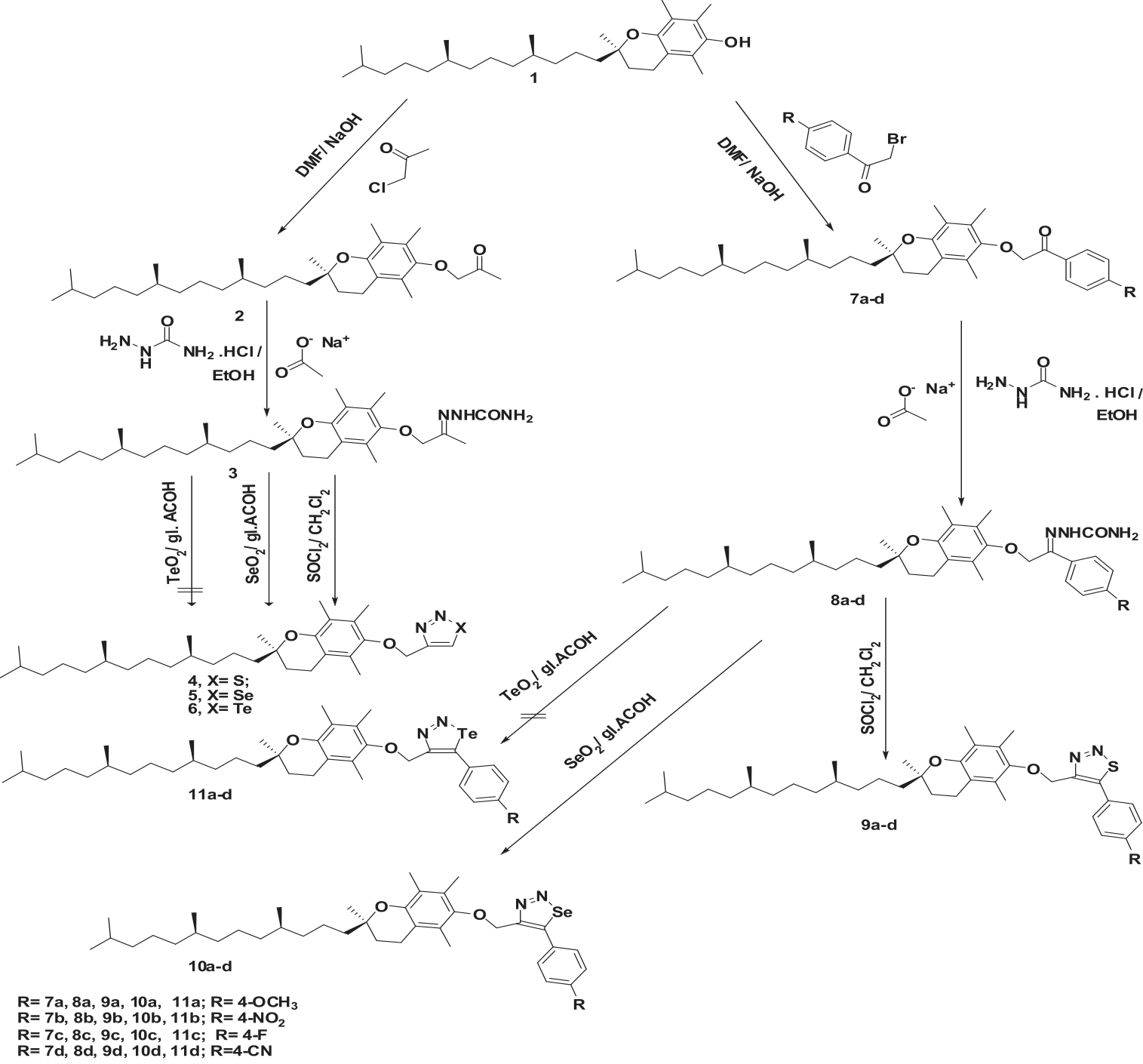
Antimicrobial Activity
Compounds (4, 5, 9a-d, and 10a-d) were studied and tested for antibacterial activity against Gram-positive (Bacillus cereus (B. cereus) and Gram-negative (Pseudomonas aeruginosa (P. aeruginosa) and Salmonella typhimurium (S. typhimurium) bacteria. The data in the findings are displayed (see Table 1). Data showed that α-tocopherol as a parent compound has no antibacterial activity against the tested organisms. Both Gram-positive and Gram-negative bacteria were inhibited by the activated synthesized compounds 4 and 9a-d. Compound 4 exhibited inhibition zones at (14) and (13) mm against Gram-negative bacteria (P. aeruginosa) and (S. typhimurium), respectively, while 9d (4-CN-substituted/1,2,3-thiadiazole/-tocopherol) showed excellent activity against Gram-positive bacteria S. aureus (19 mm) and P. Subtilis (18 mm). Furthermore, compound 9d inhibited Gram-negative bacteria (P. aeruginosa) and (S. typhimurium) in zones 15 and 16 mm. This indicates that the newly activated compound 9d, in addition to compounds 4, 9a, 9b, and 9c, have antibacterial activity and broad spectrum for both Gram (negative and positive) bacteria. From the data listed in (Table 1) the order of reactivity against bacteria as follows: 9d>9a>9c>9b>4. However, derivatives (1,2,3-selenadiazole/ α-tocopherol) (5 and 10a-d) exhibit moderate antibacterial effect against only Gram-positive bacteria, Bacillus cereus (B. cereus) & Staphylococus aureus (S. aureus). On the other hand, Gram-negative bacteria, demonstrated resistance to all compounds (5 and 10a-d). As a result, connecting vitamin e to the 1,2,3-thiadiazole ring activated the parent molecule (1) vitamin e (α-tocopherol), yielding a novel biological class of compounds 9d, 9a, 9c, and 9b in addition compound 4.
Conclusions
Thiadiazole and selenadiazole compounds were used to create a new class of Vitamin e. Vitamin e containing thiadiazoles (9a-d) shown excellent antibacterial activity and a broad spectrum against Gram-negative and Gram-positive bacteria. The antibacterial activity of derivative (9d), which contains the (-CN) group, is significantly influenced, followed by the methoxy group (-OCH3) in compound (9a), and finally the (-F) group in compound (9c). Only Gram-positive bacteria are resistant to vitamin e that contains Selenadiazoles (10a-c). Compounds (4) with vitamin e - bearing parent thiadiazoles (without any derivatives) have moderate effectiveness against Gram-positive and Gram-negative bacteria. Furthermore, Vitamin e with parent selenadiazoles (without any derivatives) has only limited action against Gram-positive bacteria. That means thiadiazole derivatives (-CN, -OCH3, F, and NO2) contribute to antibacterial action in this class of compounds.
Table 1.
Diameter of inhibition zone (mm) by synthesized compounds (4, 5, 9a-d and 10a-d) against pathogenic bacteria.

