

Introduction
The limited availability of fossil fuels, which are non-renewable resources [1], the exhaustibility of these resources [2], global warming problems [3], and increasing energy demands worldwide [4] require efficient and sustainable utilization of biomass [2- 5].
Anaerobic digestion is a process in which many biodegradable organic wastes, including agricultural [6], livestock [7], food waste [8], and sewage sludge [9], are broken down by microbial activities in the absence of oxygen, resulting in the production of biogas and digested waste that can be used for energy and soil fertilization purposes, respectively [10].
Among the biological pre-treatments, there are many studies conducted by adding microorganisms to the systems. In these studies, the processes can be accelerated by selecting the right microorganism that affects the system mechanism. The most notable increases in methane content were 37% in a reactor with single microorganism loading [11], 53.6% in a study with the addition of Bacillus paralicheniformis [12], 67% in a mixed consortium with 5% ethanol, 270% more than in a mixture with 1% glycerol [13], 85.5% in a methanogenic consortium rich in Bacteroides and Clostridium [14], 60% in a study with the addition of Kosmotoga and Rhodopyrellula [15], 76% in a consortium containing Methanobacterium formicicicum, Methanobrevibacter ruminantium, Methanisarcina frisia, Methanothrix soehngenii [16], 50% in lignocellulotic microbial consortium, 53% in consortium containing Bacteroides sp., Azospira oryzae (Dechlorosoma sp.) and Clostridiales (Firmicutes) [17]. In this study, it was aimed to determine the deficiencies and future requirements of the publications by examining the concept of “Biological Pretreatments” in biogas production processes in the Web of Science (WoS) database, the keywords used in the publications, and the relations of the related keywords with each other.
Materials and Methods
It is evident that the bibliometric method has gained importance recently. With this method, many factors, such as the number of citations related to the research area, authors who conduct research, contributions of authors, and journals, are examined. Therefore, thanks to this method, those who want to do research in the relevant field have an idea, and a road map is drawn for researchers thanks to the analysis methods used [18, 19]. The aim of this study is to evaluate the bibliometric properties of the concepts of “Biological Pretreatments” and “Bioinformatics” in biogas production processes in the Web of Science (WoS) database. Among the research on the concept of “Biological Pretreatments”, the research published in the WoS database was examined according to years, number of citations, authors, and journals. The keywords of the publications and the relationships of the related keywords with each other were analyzed. The distribution of the number of citations, categorical clustering analyses, and country distributions of the publications related to the concepts of “Biological Pretreatments” and “Bioinformatics” were visualized with the R program, and the analysis results were evaluated according to the literature. In the research, no year limit was used while searching the WoS database, but the resulting data were searched by grouping the words “methane”, “biogas”, and “anaerobic digestion” in pairs (Biological Pretreatments and Biogas; Biological Pretreatments and Methane; and Biological Pretreatments and Anaerobic Digestion) between 1986 and 2023, with the keywords “Biological Pretreatments” remaining constant. As a result of this search, 641 articles were found, and 77 of these articles were used in the study. At the same time, the words “methane”, “biogas”, and “anaerobic digestion” were binary grouped with the keyword “bioinformatics” (bioinformatics and biogas; bioinformatics and methane; and bioinformatics and anaerobic digestion). As a result of this search, 105 articles were found between 2008 and 2023. The study was conducted on these 182 articles.
Results and Discussion
Performance of Publications
When the data obtained by using the Bibliometrix package and the Biblioshiny package through the R programming language in R-Studio were evaluated (Table 1), it was determined that 77 articles were written in 27 different journals by 188 different authors using a total of 156 keywords. While the articles received 2128 citations, the Annual Growth Rate was 3.82%, and the International Co-Authorship was 33.77%. There is no single-author article on the subject; each article is written by approximately 5 authors (4.71), with an average of 43 citations per article. A total of 105 articles were published between 2008-2023 in the field of “bioinformatics” in biogas production processes. The articles were written in 61 different journals, by 399 different authors, and used 342 keywords in total. While the articles received 5786 citations, the Annual Growth Rate was 21.69%, and the International Co-Authorship was 33.33%. There is no single-author article on the subject; each article is written by approximately 6 authors (5.63), with an average of 21 citations per article.
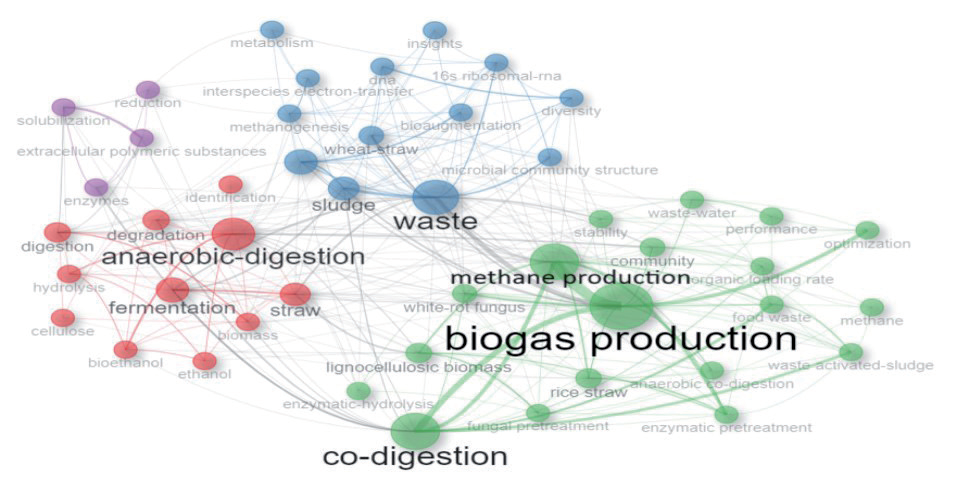
With the co-occurrence/co-word analysis (Fig. 1), it is determined that the research related to the concept of “Biological Pretreatments” in biogas processes is mostly used together with the keywords anaerobic digestion, biogas production, co-digestion, methane production, and lignocellulosic biomass. This situation shows that biological pretreatments are used to combat lignocellulosic materials that affect the efficiency of biogas processes. Fig. 1 shows that the keywords methane production, co-digestion, organic loading rate, community, and food waste were used together, and methanogenesis and bacteria were used together in the research related to the concept of “bioinformatics”. When the concepts of “biological pretreatments” and “bioinformatics” were evaluated together, it was understood that the keywords biogas production, co-digestion, anaerobic digestion, waste, and fermentation were used together.
Table 1.
. Information on the Data Used.
Important Information Obtained as a Result of the Analysis
Due to the difficulties in the decomposition of lignocellulosic materials, physical, chemical, and biological pretreatments have started to be used in biological processes. The use of biological pretreatments in biogas processes has reached the present day, starting with the study of white rot fungi used by Müller and Trösch [20]. In this study, which is known as the first study in the literature [20], it was aimed at increasing the biogas potential by using 22 white rot fungi for the degradation of lignin, cellulose, and hemicellulose.
At the level of bioinformatics studies, it was revealed that the first bioinformatics study, which was not directly related to biogas studies, started with the structural bioinformatics analysis of enzymes by Kaminska [21]. In addition, bioinformatics studies were carried out by Welander and Summons [22] for the discovery of a gene required for 3-methylhopanoid production, by Wang [23] for structural bioinformatics analysis of enzymes, and by Li [24] to identify the alkane hydroxylation system in the cold-resistant bacterium Pusillimonas sp. T7-7. The first study in which bioinformatics studies were directly used in biogas processes was the prediction of the glycosyl hydrolase (GH) gene by bioinformatic analysis by Yan [25]. Following this study, Kumar [26] studied DNA sequencing technologies and bioinformatics to identify new directions and strategies for methane reduction from ruminants. According to Demidenko [27], fatty acid biosynthesis in Methylomicrobium buryatense 5G(B1) was investigated, and it was understood that most of the homologous genes could be explained by bioinformatic analyses. Stoyancheva [28], Metagenomic Analysis of Bacterial, Archaeal, and Fungal Diversity in Anaerobic Biodegradation, revealed that the dominant genera among methanogenic archaea were Methanothrix (8.03%) and Methanosarcina (3.39%).
Conclusions
There are many variables affecting the efficiency of biogas processes. These variables may be related to the problems encountered during the operation of anaerobic reactors. In addition, the material fed to the reactors also affects the process efficiency. Materials with a high cellulosic content can be very difficult to digest. Various physical, chemical, and biological pretreatments can be used to facilitate substrate digestion. Among biological pre-treatments, the addition of microorganisms stands out. In anaerobic systems, it has been shown that the addition of microorganisms present in the process and involved in methane production to the system has positive effects on the process efficiency.
Bibliometric analysis is considered an evaluation of past studies. However, this analysis is also a very important tool that can be used to determine how the studies on biological pre-treatments have changed and at what levels this change has occurred. In the studies on biological pre-treatments, some applications were carried out until 2018 for the purpose of recovery and digestion of lignocellulosic wastes. Since 2008, with the increase in technological development and accessibility, the use of bacteria, fungi, and studies on the DNA structures of these microorganisms has increased. Furthermore, within the scope of new technology and possibilities, it will be possible to increase the specific methane amount by increasing the enzyme yields and growth rates of microorganisms working in the hydrolysis, acidogenesis, acetogenesis, and methanogenesis stages of biogas processes by intervening in the desired gene region with the help of gene transfer (cloning).
With this study, it has been determined that bioinformatics studies on microorganisms used in systems and processes where microorganisms are used in biogas processes are increasing day by day. However, genetic studies in biogas processes are not used for controlled gene exchange with cloning processes. It is understood that it is generally used for the species identification of microorganisms. Therefore, they concluded that studies on cloning processes, which are required by biological pre-treatments used in biogas processes, should be given importance, and studies on these issues should be increased.

