

Introduction
The primary goal of the Rural Revitalization strategy is to promote agricultural supply-side reforms, increase farmers' income, and boost the green transformation of the agricultural sector [1]. However, limited by production technology and available farmland, most farmers can only rely on increased fertilizers and pesticides to ensure output. This results in a series of problems, such as decreased soil fertility, degradation of farmland, and low product quality. For this reason, requirements such as "cultivating new agricultural business entities, promoting agricultural and rural modernization, and implementing rural revitalization strategies" were put forward at the 19th National Congress of the Communist Party of China. In 2018, the No. 1 document of the Central Committee also proposed "the implementation of a new type of agricultural business entity cultivation project." Family farm refers to a new type of agricultural production and operation entity. This new entity primarily relies on family members for labor; engages in large-scale, commercialized, and intensive production and operations; and generates a family income based on agriculture [2]. Compared with the traditional small-scale land operation, family farms have a stronger willingness to adopt green agricultural technology due to their large-scale production. This makes the family farm an important instrument for the adoption of green agricultural technology.
Scholars at home and abroad have done some research on factors affecting the adoption of technology and its application by farmers. Wang believes there is a link between a farmer's level of education and their willingness to adopt new agricultural technologies [3]. Doss and Morris [4] believe that the gender of farmers has a significant impact on the demand for technology. Lerman [5] believes that the spread of new agricultural technologies and services is closely related to government financing. Maumbe and Swinton [6] believe that the lower the age of farmers, the more willing they are to adopt new agricultural technologies. Hunecke et al. [7] believe that the income level of farmers – and their awareness of environmental protection have a significant positive impact on their adoption and application of agricultural technology.
Through the examination of relevant studies, it has been found that scholars at home and abroad are inclined to study the demand of traditional production technology among small-scale farmers; however, there are few studies when it comes to the adoption behavior and influencing factors of green agricultural technology on family farms. China, a large grain-producing country and a populous country, has fed 20% of the world's population with 9% of its arable land. Adoption of agricultural green production technologies is an effective measure to reduce environmental pollution caused by agricultural production. Studying on the adoption of green agricultural technology adoption is necessary for a green-oriented transition of agriculture. Therefore, this paper bases its research on family farm survey data from the Jiangsu Province. Cluster stratification and the Logit model were used to empirically analyze the level of desire and influencing factors related to the adoption of agricultural technology by family farmers. Starting from the rational smallholder and social network theories, this paper focuses on the underlying reasons influencing family farmers' demand for green agricultural technology. The study found that family farmers tend to adopt improved seed technology, water-saving irrigation technology, high-efficiency pesticide spray technology, and soil testing formula fertilization technology. This decision is closely related to capital endowment, market economic returns and surrounding social networks. In doing so, we hope to facilitate green agricultural transformation in China. Furthermore, this paper addresses the existing gaps in research on family farms and green agricultural technologies, consequently serving as a valuable reference to better studying the adoption of green agricultural technologies among new entities.
Theoretical Analysis and Research Hypotheses
Theoretical Analysis
Maslow, an American psychologist, divides human needs into five levels: physiological, safety, social, esteem, and self-actualization. Only after the lower level of needs are satisfied will people pursue the higher levels of needs [8, 9]. Just as people's needs change depending on the situation they find themselves in, farmers' needs for agricultural technology change as well [10]. This change is not only affected by differences in farmers' capital, but is also closely related to the external market conditions and the influence of relatives and friends around them [11]. Therefore, when studying farmers' willingness to adopt agricultural technology, two types of factors should be taken into account: the farmers' own situation and external social factors. The priority a farmer places on different technological needs should also be understood, as well as the underlying reasons for these priorities [12, 13].
American scholars Schultz and Popkin are the representatives of the theory of "rational smallholder," which holds that farmers are thoughtful "rational economic men" who will allocate resources rationally to maximize profits [14]. Before adopting a new technology, farmers will consider the rate of return on investment that the technology brings. Only when the expected market benefit of the new technology is greater than the old technology, will the farmers adopt the technology. Gao Shan et al. found that market income pair is an important factor driving behavioral changes in farmers. Therefore, the allocation of agricultural resources through market mechanisms is an effective way to change farmers' willingness to adopt technology [15].
The British scholar R. Brown first proposed the concept of social network, which has a short transmission path in improving the efficiency of technological promotion [16]. Farmers' access to green agricultural technology through social network can effectively explain relevant technical characteristics, and can reduce the cost of information acquisition. In addition, the social network among farmers is formed on the basis of mutual understanding. Thus, there is a good foundation of trust between them, which facilitates the popularization of new technologies [17]. This can also reduce the risk of technology use to a certain extent, and can improve its overall utilization. As rational economic actors, farmers will pursue their own maximum benefits, and constantly strive to meet their own higher level of demand. The relationship network around them will also have a certain impact on their choice [18]. The analysis of the needs of family farmers associated with green agricultural technology should not only take into account the differences in household capital, but also the economic benefits and social networks at play [19]. Therefore, this paper proposes the hypothesis that household capital, economic return, and social network are the influencing factors of family farmers' demand for green agricultural technology. This paper also compares and analyzes the differences and connections among these three variables.
Research Hypotheses
Taking into account the current situation in Jiangsu Province, the factors influencing family farmers' demand for green agricultural technology are summarized into three aspects: capital endowment, economic return, and social network. The green agricultural technology studied in this paper includes improved seed technology, soil testing formula fertilization technology, water-saving irrigation technology, physical pest control technology, biological pest control technology, efficient pesticide spray technology, mechanized production technology, and soil improvement technology.
Capital Endowment
This paper divides farmers' capital endowments into three aspects: natural capital, economic capital, and human capital. Natural capital refers to the productive acreage owned by farmers. The larger the productive acreage owned by farmers, the more likely they are to invest in green agricultural techniques to generate economies of scale. Economic capital refers to the agricultural net income of farmers. The higher the agricultural net income of farmers, the more sufficient the funds will be and the more active the farmers will be in adopting the emerging green agricultural technologies. Human capital refers to the gender, age, education level, and proportion of agricultural labor in the household. Men are more likely to adopt green farming techniques because they are out and about more than women and have a wider vision. Farmers are less motivated to adopt new green agricultural technologies as they get older. The more educated farmers are, the wider their knowledge is, and the stronger their ability to learn new technologies. Thus, they are more likely to apply green agricultural technologies to agricultural production. Likewise, the larger the proportion of agricultural workers in the household, the more likely farmers are to adopt green agricultural technologies. Based on this, six hypotheses are put forward as follows:
Hypothesis 1a: Productive acreage has a positive effect on the adoption of green agricultural technologies.
Hypothesis 1b: Agricultural net income has a positive effect on the adoption of green agricultural technologies.
Hypothesis 1c: Men are more likely to adopt green agricultural technologies.
Hypothesis 1d: Age has a negative effect on the adoption of green agricultural technologies.
Hypothesis 1e: Education level has a positive effect on the adoption of green agricultural technologies.
Hypothesis 1f: The proportion of agricultural workers in the household has a positive effect on the adoption of green agricultural technologies.
Economic Return
As a rational economic actor, family farmers' investment behavior is inevitably affected by economic returns. This study divides family farmers' perception of economic returns into the following aspects: market expectation, input cost, brand products, and level of difficulty. Specifically, the hypothesis is that when farmers perceive that the application of green agricultural technology can increase economic benefits, they will be more active in its application. The less money and labor it costs to use the technology, the more farmers will adopt it. Brand products can guarantee a certain market share; thus, when farmers produce brand products, they will adopt green agricultural technology to ensure product quality and safety. When the technical difficulty coefficient is large, the opportunity cost for farmers to learn the technology is higher, and the technology adoption rate is reduced. Based on this, this paper proposes the following hypotheses:
Hypothesis 2a: The market expectation has a positive effect on the adoption of green agricultural technologies.
Hypothesis 2b: The input cost has a negative effect on the adoption of green agricultural technologies.
Hypothesis 2c: Compared with ordinary products, farmers have a higher adoption rate when producing brand products.
Hypothesis 2d: The level of difficulty has a negative effect on the adoption of green agricultural technologies.
Social Network
The family farmer's social network is made up of neighborhood relationships. Social network has an important influence on the adoption and application behavior of green agricultural technology. This study divides the social network of family farmers into three dimensions: network size, network resources, and network interaction. The larger the farmers' network, the more contacts they have, the more likely they are to borrow investment funds, and the more likely they are to adopt new technologies. The more relatives and friends that are engaged in other occupations, the more likely the farmer is to receive information about green agricultural technologies, and the more likely they are to adopt them. The more frequent the interactions between farmers and village technicians, the more knowledge they can acquire about green agricultural technologies and the more likely they are to adopt them. In summary, three hypotheses are proposed in this paper:
Hypothesis 3a: The network size has a positive effect on the adoption of green agricultural technologies.
Hypothesis 3b: The network resources have a positive effect on the adoption of green agricultural technologies.
Hypothesis 3c: The network interaction has a positive effect on the adoption of green agricultural technologies.
Data and Methods
Data Source
The data in this paper came from the field survey of family farms in Jiangsu Province conducted by the research group in June-July 2018. Located on the southeast coast of my country, Jiangsu Province is a strong economic province and an important agricultural region. Family farms in Jiangsu Province have become an important vehicle for increasing farmers' income and a new force in the development of modern agricultural, while presenting a diversified and multi-type development trend. Considering the level of economic development and the distribution of family farms, the rural areas of six prefecture-level cities were selected as the research sites. These sites were chosen from cities, such as Zhenjiang, Taizhou, Yangzhou, Huai ‘an, Yancheng and Suqian. This survey mainly focuses on the adoption behavior of family farmers in regards to green agricultural technology. In order to ensure the authenticity of the questionnaire, a random sampling method was adopted for both the interview and survey. Questionnaires were filled out through face-to-face interviews between investigators of the research group and family farmers. These were then completed by the investigators. In this survey, a total of 269 questionnaires were sent out and 243 were recovered. After screening, 229 valid questionnaires were obtained.
Sample Characteristics
The basic characteristics of sample farmers are shown in Table 1. The majority of respondents were male, accounting for 86.03%. In addition, 72.36% of family farmers were 45 years old or older and 26.64% of family farmers were 45 years old or younger. This indicates the typical ages of family farmers as a whole. The education level of farmers was mainly primary and junior high school, accounting for 71.61% of the total sample. This indicates that the educational level of the sample farmers is generally low, and more than half of the family members are engaged in agricultural work, accounting for 74.67%.
Descriptive Analysis
The willingness of farmers to choose green agricultural technology is the result of the influence of a variety of factors. First, there is the capital endowment of farmers. Secondly, there is the economic benefit related to the technology itself. And finally, there is the social network that the farmer belongs to. The dependent variables and explanatory variables are described in Table 2.
Table 1.
Basic Characteristic of Sample Farmers.
Model Assumption
Logit Model
The Logit model is a discrete mathematical analysis model that was first proposed by Fechner in 1860 and later expanded by Professor Warner. Since the 1970s, the Logit model has been widely applied and has played a significant role in management decision-making [20]. In this paper, the Logit model was adopted to analyze the influencing factors of family farmers' willingness to adopt green agricultural technologies, and Eviews 7.0 was used for regression analysis. The specific model was set as follows:
Where, ϑ is latent variable, unobtainable variable, and x' is explanatory variable. The technical selection rules for family farmers are:
Assuming that the random disturbance term obeys the cumulative distribution, then:
Hierarchical Cluster
Hierarchical cluster is a method of clustering analysis that involves building a cluster hierarchy. This method calculates the distance (similarity) between data points of different categories by using the Euclidean distance matrix. The smaller the distance, the higher the similarity. This method combines the two data points or categories with the closest distance to form a clustering tree. SPSS Version was used for statistical analysis.
Table 2.
Meaning of variables and descriptive statistical analysis.
Based on the above two methods, this study conducted sample characteristics description and descriptive analysis. In order to further investigate the degree of demand for green agricultural technologies, this paper also used the "hierarchical clustering" method to stratify and rank various technologies. Ultimately, the regression results of various green agricultural technologies were calculated to explore the impact of different variables on the adoption of green agricultural technologies. The flowchart for research is shown in Fig. 1.
Likelihood of Family Farms to Adopt Green Agricultural Technology
In the questionnaire, family farmers selected and ranked the four most needed green farming technologies out of the eight listed. The results are shown in Table 3. Improved seed technology was ranked first by 109 family farmers. Second, was water-saving irrigation technology. Highly efficient pesticide spray technology appeared most frequently in the third position, and with 81 responses, soil testing and formulation technology appeared most frequently in the fourth position.
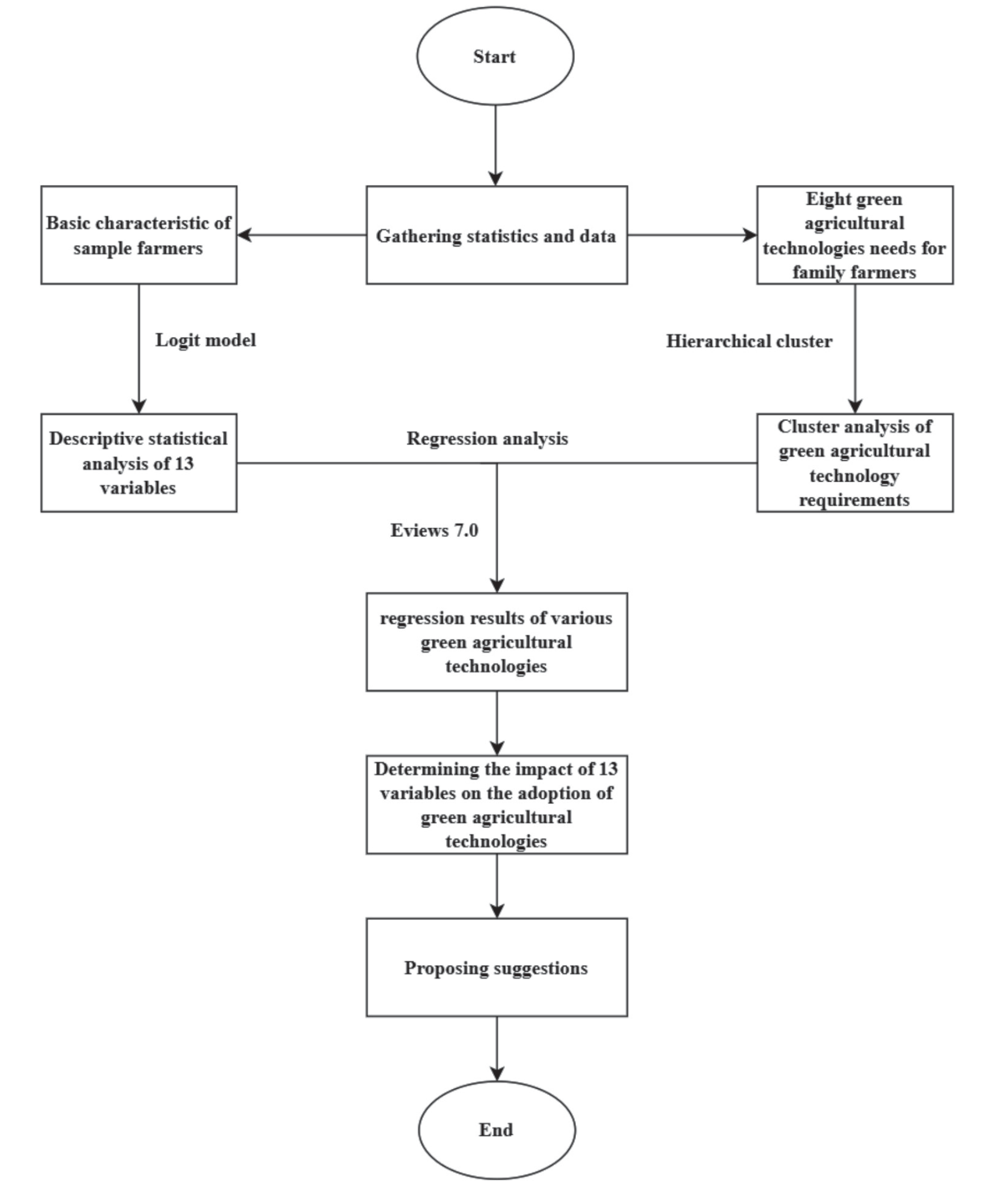
Table 3.
Ranking of Green Agricultural Technology Needs of Family Farmers.
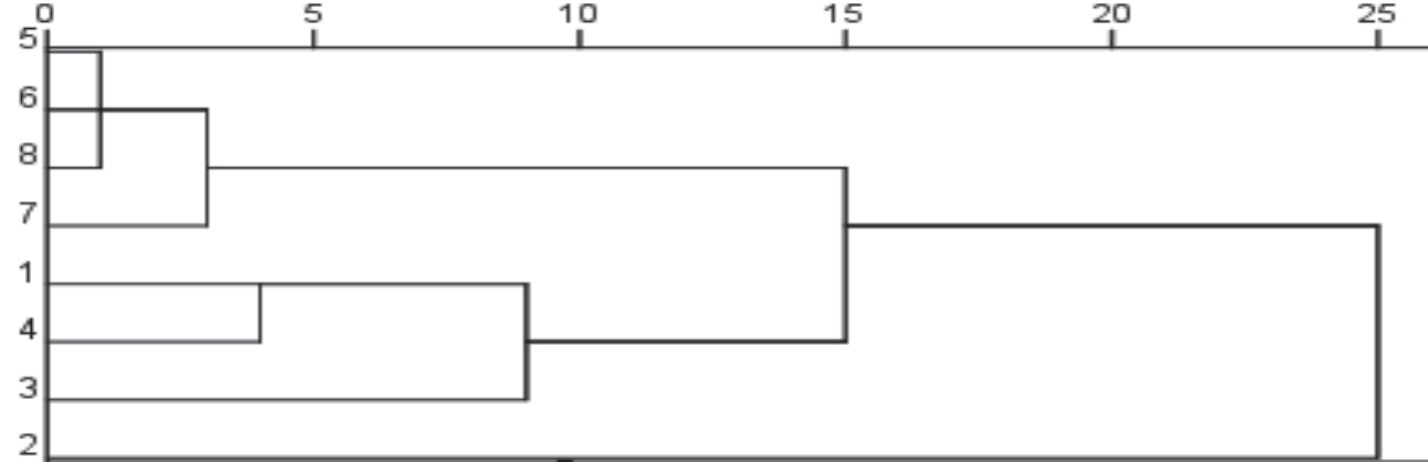
Because the eight green agricultural technologies show up in different positions at different times, it is impossible to rank them effectively. Therefore, this paper uses the "hierarchical clustering" method to stratify and rank these green agricultural technologies.
According to the results in Fig. 2, it can be seen that these eight green farming technologies can be clustered into three categories according to the demand of family farmers. The specific explanations are as follows.
The first level is the improved seed technology. The improvement of crop yield depends on high quality seeds, material inputs, and production management. However, material input and production management can only play an important role in increasing production through good seed quality. According to Maslow's Hierarchy of Needs, good varieties can provide farmers with the most basic high-quality means of production. Only under such basic conditions will farmers continue to think about the adoption and application of other agricultural technologies. Improved seed technology was ranked first 109 times, indicating that family farmers have a greater need for improved seed technology and can fully demonstrate its importance. The second level is comprised of high-efficiency pesticide spraying technology, water-saving irrigation technology, and soil testing fertilization technology. These technologies are closely related to crop growth, and efficient pesticide spraying technology can reduce pesticide consumption while protecting the environment. Water-saving irrigation technology can create suitable water conditions for crops, increase crop yield, and save labor. The technique of applying soil-measurement fertilizer can maximize the absorption of chemical fertilizer by plants, reduce retention in the environment, improve the soil quality, and increase the utilization rate of fertilizer. Combined with Table 4 and the clustering tree diagram, this level is ranked in the following order: water-saving irrigation technology, high-efficiency pesticide spraying technology, and soil-measurement fertilizer application technology.
The third level is comprised of biological pest control technology, physical pest prevention and control technology, mechanized production technology, and soil improvement technology. The demand of family farmers can be ranked in the following way from strongest to weakest: physical pest control technology, soil improvement technology, mechanized production technology, and biological pest control technology. According to the survey interviews, family farmers focus on the actual growth of crops, but are not strong enough to face the demand of mechanized production and other management aspects.
Fig. 2.
Cluster analysis of green agricultural technology requirements Note: 1 = High-efficiency pesticide spraying technology; 2 = Improved seed technology; 3 = Soil-measurement fertilizer application technology; 4 = Water-saving irrigation technology; 5 = Biological pest control technology; 6 = Physical pest prevention and control technology; 7 = Mechanized production technology; 8 = Soil improvement technology.
Analysis of Factors Influencing the Willingness of Family Farmers to Adopt Green Agricultural Technology
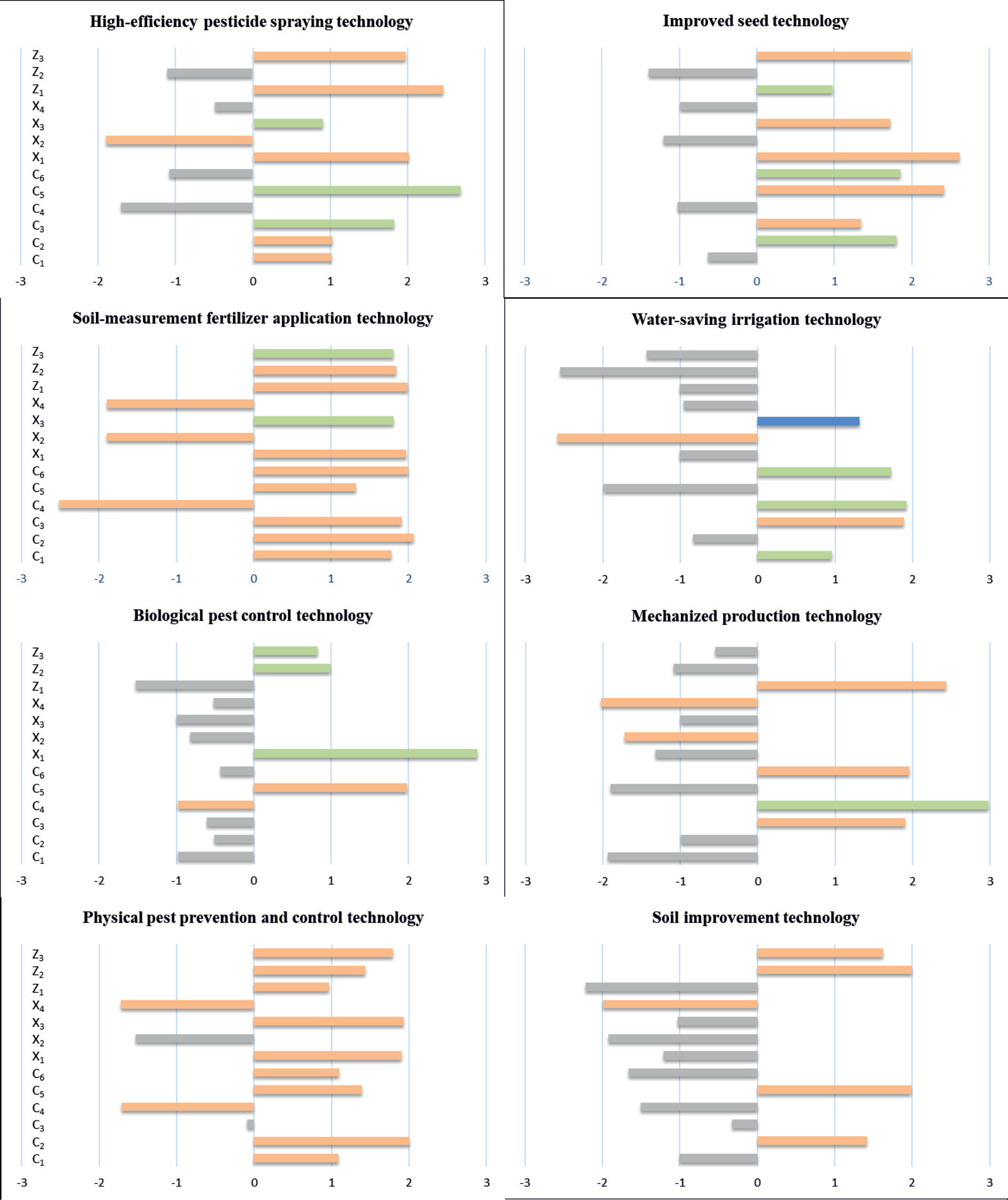
In this paper, Logit regression analysis was conducted on 229 survey results using the econometric software Eviews 7.0. Taking all 13 variables of family farmers' willingness to adopt green agricultural technology into account, the fitted equations for each green farming technology in Table 5 are statistically significant overall; however there are large differences in the estimated coefficients of each explanatory variable, inconsistent signs of each explanatory variable across green farming technologies, and also some statistical insignificance.
Capital Endowment
The variable of "production area" has a significant positive effect on four technologies, including "high-efficiency pesticide spraying technology," "soil-measurement fertilizer application technology," "water-saving irrigation technology," and "physical pest prevention and control technology." This was consistent with the expected hypothesis 1a. The larger the production area of the family farm, the more water, fertilizer, inputs and other production materials are needed. It is clear from the actual research interviews that the use of these technical measures can guarantee output while both improving the efficiency of production materials and, to a certain extent, saving money. The variable of "agricultural net income" reached the significance level in five technology models: "high-efficiency pesticide spraying technology," "improved seed technology," "soil-measurement fertilizer application technology," " physical pest prevention and control technology," and "soil improvement technology." All of these had a positive coefficient. This was consistent with the expected hypothesis 1b that the higher the net agricultural income, the more active the family farmers would be in adopting these technologies.
The "gender" variable had a significant positive effect on the five green agricultural technologies: "high-efficiency pesticide spraying technology," "improved seed technology," "soil-measurement fertilizer application technology," "water-saving irrigation technology," and "mechanized production technology." This indicates that males are more inclined to adopt these technologies, consistent with hypothesis 1c. The variable "age" was significant and positive at the 5% level for "water-saving irrigation technology" and "mechanized production technology," while it had a significant negative effect on "soil-measurement fertilizer application technology," "biological pest control technology," and "physical pest prevention and control technology." This suggests that the older family farmers are, the more likely they are to adopt green farming techniques that are labor-saving, but also more conservative. From the research interviews, we know that most of the older farmers are deciding on the amount of fertilizer and inputs based on their years of experience, and are skeptical of some of the emerging green agricultural technologies.
The variable of "educational level" reached the significant level in six technical models, including "high-efficiency pesticide spraying technology," "improved seed technology," "soil-measurement fertilizer application technology," "biological pest control technology," "physical pest prevention and control technology," and "soil improvement technology." This coefficient was positive, which was consistent with the expectation. The more educated the family farmers are, the better their knowledge system is, the faster they can master new technologies, and the more open-minded they are. All of this makes them willing to adopt a variety of green agricultural technologies. The "proportion of agricultural labor" variable had a significant negative influence on five technologies, including "improved seed technology," "soil-measurement fertilizer application technology," "water-saving irrigation technology," "mechanized production technology," and "physical pest prevention and control technology", which is contrary to hypothesis 1f. The smaller the proportion of family members engaged in family farm operation and management, the more they hope to increase the controllable factors in the process of production and operation. Thus, they are more inclined to use green agricultural technologies that are helpful for managing water and fertilizer use and reducing labor requirements.
Economic Benefits
By comparing the corresponding results of various technologies, it was found that the "market expectation" variable reached a significant level in five technical models, including "high-efficiency pesticide spraying technology," "improved seed technology," "soil-measurement fertilizer application technology," "biological pest control technology," and "physical pest prevention and control technology." Here, the resulting coefficient symbol was positive. The more family farmers expect to gain from the market economy, the more active they will be in adopting various green agricultural technologies, and the more they will increase their investment in green agricultural technologies. The variable of "input cost" has a significant negative influence on the four technologies, such as "high-efficiency pesticide spraying technology," "soil-measurement fertilizer application technology," "water-saving irrigation technology," and "mechanized production technology." This suggests that the lower the input cost of these technologies, the more likely family farmers are to adopt them.
The variable of "brand product" has a significant positive influence on "high-efficiency pesticide spraying technology," "improved seed technology," "soil-measurement fertilizer application technology," "water-saving irrigation technology," and "physical pest prevention and control technology." Family farmers pay extra attention to the quality and taste of the branded products they produce, and strictly control everything from the selection of high-quality seeds to the use of water, fertilizer, and other inputs in order to protect their reputation in the market.
Table 4.
Regression results of various green agricultural technologies.
The "difficulty degree" variable reached a significant level in four technologies, including "soil-measurement fertilizer application technology," "mechanized production technology," "physical pest prevention and control technology," and "soil improvement technology." The resulting coefficient here was negative. The lower the difficulty of technology adoption, the lower the opportunity cost for the family farmer to learn the technology, and therefore the more likely the family farmer is to adopt the four technologies. These were consistent with the hypothesis 2(a-d).
Social Network
The variable of "network size" reached a significant level in five technologies, including "high-efficiency pesticide spraying technology," "improved seed technology," "soil-measurement fertilizer application technology," "mechanized production technology," and "physical pest prevention and control technology." The coefficient symbol for this was positive. The more well-connected family farmers are, the more money they can borrow and invest, and the more motivated they are to adopt green agricultural technologies. The variable of "network resources" had a significant positive influence on the four technologies, including "soil-measurement fertilizer application technology," "biological pest control technology," "physical pest prevention and control technology," and "soil improvement technology." The greater the number of friends and relatives the family farmer has who are engaged in other occupations, the more opportunities there are to obtain effective information. This in turn helps the farmer to expand his horizons and actively accept new technologies.
The variable of "network interaction" had a significant positive influence on six technologies, including "high-efficiency pesticide spraying technology," "improved seed technology," "soil-measurement fertilizer application technology," "biological pest control technology," "physical pest prevention and control technology," and "soil improvement technology." This shows that the more family farmers communicate and learn from village technicians, the more active they will be in adopting green agricultural technologies. These were consistent with the hypothesis 3(a-c). Surveys and interviews have found that family farmers generally want agricultural experts to get out into the field and demonstrate the technology themselves, so that they get the most out of it. However, when compared with the coefficient of the variable, "market expectations," it is significantly lower. The reason for this may be that family farmers, as rational economic actors, pay more attention to the long-term return on investment. If the investment in this technology cannot achieve a certain economic return, their demand and willingness for this technology will be affected and their enthusiasm for adoption will be reduced. The results are presented in Fig. 3.
Conclusions and Suggestions
Based on the Hierarchy of Needs Theory, Rational Small Farmer Theory, and Social Network Theory, this paper analyzes the way in which family farmers prioritize their green agricultural technology needs. It also examines the influence of family farmers' capital endowment, economic return, and social network on their willingness to adopt green agricultural technology. Green agricultural technology is an important environmentally friendly technology. Adoption of green agricultural technology in production management can not only effectively improve the quality of agricultural products, but also benefit the sustainable development of the natural environment. The willingness of family farmers to adopt green agricultural technologies is closely related to not only their own capital endowment, but also the benefits of the market economy and the social network surrounding them.
The family farmers' demand for green agricultural technology comes in the form of improved seed technology, water-saving irrigation technology, high-efficiency pesticide spraying technology, soil-measurement fertilizer application technology, physical pest prevention and control technology, soil improvement technology, mechanized production technology, and biological pest control technology. It can be seen that the top four technologies are closely related to crop growth, indicating that farmers pay close attention to various aspects of the actual growth of crops. Only after family farmers have mastered the basic growth of crops will they seek to address their technical needs in other areas.
The size of production area and the agricultural net income of family farms are variables that both have a significant positive impact on the willingness of family farmers to adopt green agricultural technology. Likewise, the variables of gender, age, and educational level of family farmers also have a significant impact on their willingness to adopt this technology. The greater the perceived economic benefits to the market, the more actively farmers will adopt green farming technologies, and the more they will tend to adopt technologies with lower input costs. Social network relationships around family farmers also had a significant effect on their willingness to adopt green farming technologies, but by comparing this with the economic return category, it was found that expected market returns incentivized the adoption of green farming technologies.
Based on the above findings, the following recommendations are made. First, improve the land transfer system to promote the development of family farms. Land transfer is the basis for developing large-scale production and operation. The land transfer system should be continuously improved, land transfer forms should be actively explored, and farmers should be encouraged to actively participate in it. At the same time, it is necessary to promote the healthy development of family farms, so as to drive the surrounding farmers to actively adopt green agricultural technologies and achieve sustainable agricultural development. Second, implement professional farmer training programs to comprehensively improve the overall literacy of farmers. New professional farmers play an important role in the green transformation of agriculture. New professional farmer cultivation programs should be actively implemented to improve farmers' quality and agricultural skills. They should also implement precise training related to their goals, needs, and problems in order to improve farmers' overall literacy and thereby make them more willing to adopt green agricultural technologies. This will help strengthen the green transformation of agriculture. Third, create a good market economy and promote the development of green brand agriculture. A good market economy helps to allocate agricultural resources rationally and maintain the development of the natural environment. The role of market and government should be given full play to create a market that facilitates the sale of green agricultural products. At the same time, we should strengthen the branding of green agricultural products, actively create local special brands and promote the development of green brand agriculture. Fourth, optimize the social network resources of farmers and actively carry out technical exchange activities. The development of farmers' social network resources can help the dissemination and application of green agricultural technologies. A good social living environment should be created to continuously provide farmers with high-quality social network resources, and farmers should be provided with opportunities to exchange and learn green agricultural technologies in various forms and aspects. This will increase farmers' understanding and mastery of these technologies, and make them more enthusiastic about adopting them.
In general, this paper fills the gap in the literature on the adoption of green agricultural technologies from a family farm perspective. It provides compelling evidence that capital endowment, economic return and social network can positively or negatively influence the adoption of different green agricultural technologies. Therefore, this paper may have the following points that can inspire future studies.
(1) New entities have a significant role in promoting the adoption of green agricultural technologies. This paper has not yet fully discussed new entities except family farms, and suggests that more attention can be paid in future research. (2) Rural areas with different levels of economic development may have different attitudes towards the adoption of green agricultural technologies. This paper chose the economically developed region of Jiangsu as a study area. There are still some gaps in the research on the adoption of green technologies in other rural areas. Research on family farms can be extended globally to explore new ways to drive the adoption of green technologies, and it is suggested that the research on less developed regions can be further deepened in future research.

