

Introduction
Since the reform and opening up in 1978, China’s urbanization has developed rapidly, with the proportion of the urban population rising from 17.92% in 1978 to 63.89% in 2020. However, rapid urbanization has resulted in the consumption of a large amount of fossil energy, leading to a sharp rise in carbon dioxide emissions and the emergence of new environmental issues [1, 2]. Accelerating the adjustment of the energy structure and improving energy efficiency are the keys to achieving an energy transition [3]. The Chinese government has implemented a series of policies aimed at reducing carbon emissions. For example, in 2010, the National Development and Reform Commission issued a notice to carry out pilot work on low-carbon provinces and cities. At the 75th United Nations Climate Conference in 2020, the Chinese government made a commitment to reach carbon peak by 2030 and achieve carbon neutrality by 2060 [4]. However, achieving these goals is not an easy task. Coal still accounts for a significant proportion of energy consumption in China. The proportion of traditional energy sources in China’s energy consumption structure is about 82.71%, with coal in particular accounting for 54.66% [5]. Therefore, reducing urban carbon emission intensity and seeking a new model of urban sustainable development under the “double carbon” goal have become urgent issues that need to be addressed. The construction of civilized cities has been considered one of the measures to promote urban sustainable development in China for nearly 20 years. The State Civilization Commission announced the selection criteria for civilized cities as early as 2003 and implemented the first civilized city pilot project in 2005. The title of “Civilized City” is an honorary distinction. The goal of constructing a civilized city is to establish a sustainable urban development model that embodies Chinese characteristics. This model serves as an engine to promote high-quality urban development [6]. As the most valuable and highest-quality city honorary distinction, the pilot program of the civilized city provides institutional support for urban development and transformation [7]. As a result, civilized city construction has an impact on urban carbon emissions. This study aims to examine the impact of civilized city construction on urban carbon emission intensity and explore any heterogeneity in this influence. Understanding the relationship between civilized city construction and carbon emission intensity will help to evaluate the carbon reduction effectiveness of civilized cities and improve the formulation and implementation of carbon reduction policies. To achieve this, the study uses the construction of civilized cities in China as a quasi-natural experiment and employs the multi-period difference-in-differences model (DID) to assess the impact of civilized city policies on carbon emission intensity, as well as analyze the transmission mechanism behind this impact.
The following arrangement of this study is as follows: The second part reviews the relevant literature on civilized city construction and carbon emissions; the third part provides details on the research methods and data sources; the fourth part presents the empirical analysis, including baseline regression, parallel trend tests, placebo tests, and robustness tests; the fifth part analyzes the mechanisms and heterogeneity in the impact of civilized city construction on carbon emission intensity; and the sixth part draws the research conclusion.
Literature Review
This paper aims to analyze the impact of construction in a civilized city on urban carbon emission intensity. Existing literature primarily focuses on the outcomes of civilized city construction, the effects of external policies or events on urban carbon emissions, and the exploration of the relationship between civilized city creation and urban carbon emissions.
Firstly,in terms of the effectiveness of civilized city construction, it mainly investigates its economic and ecological effects. City branding, as a common form of policy intervention, can facilitate regional economic development by attracting capital and talent [8, 9]. For example, Gomes and Librero-Cano (2018) evaluated the impact of the European Capital of Culture program on GDP per capita using the difference-in-difference model and found that it contributes to economic growth [10]. Chen and Mao (2021) discovered that the selection of civilized cities promotes the growth of the urban tourism economy [11]. Furthermore, some scholars have noted that selecting a civilized city can also promote urban development, official promotion, and residents’ happiness [12]. When evaluating the ecological effects of civilized cities in China, researchers primarily focus on both city and enterprise levels. Yang et al. (2022) pointed out that the civilized city pilot project promotes urban green innovation through increased innovation capital input and environmental regulation [13]. Additionally, some scholars have studied the impact of civilized city construction on energy use efficiency and its underlying mechanisms. Li et al. (2022) examined the relationship between civilized city construction and energy efficiency, discovering a significant positive correlation between the two. They also identified technological innovation as the channel through which civilized cities achieve energy-saving effects [14]. In addition, few researchers have delved into the impact of civilized city selection on corporate environmental performance [15].
Secondly, in terms of the impact of external policies or events on urban carbon emissions, Toebelmann and Wendler (2020) found a significant negative correlation between environmental innovation and urban carbon emissions, while general patents unrelated to the environment had no significant effect [16]. Highlighting the importance of environmental policy tools, Baghdadi et al. (2013) discovered that regional trade agreements with environmental provisions continuously and positively affected energy conservation and emission reduction [17]. Gehrsitz (2017) analyzed the effectiveness of low-carbon cities in Germany using a difference-in-differences model and found that low-carbon city construction significantly reduced urban carbon emissions [18]. Nguyen et al. (2019) found that Japan’s carbon emissions trading scheme was beneficial for reducing carbon emissions [19]. However, contradictory findings also exist. For example, Wang and Qiu (2021) observed that the effect of energy-saving and emission reduction demonstration cities initially increased significantly but gradually decreased over the long term [20].
Thirdly, in terms of the relationship and intermediary effect between the construction of a civilized city and carbon emission intensity, Shi et al. (2022) proposed that the establishment of civilized cities lays a solid foundation for urban green development by increasing financial investment in environmental governance [21]. Some scholars have found that the construction of civilized cities reduces carbon emissions by promoting industrial restructuring from secondary to tertiary industries. However, this reduction effect is only the result of the adjustment in industrial structure and does not consider the impact on the technological level, among other factors [22]. Other scholars have discovered that civilized cities typically enhance carbon efficiency by mobilizing local governments to participate in green development practices [23].
In summary, although there are many academic studies on the construction of civilized cities and urban carbon emissions, there are still shortcomings in the existing studies: First, in terms of research perspectives, most of the existing literature focuses on the construction of civilized cities or on carbon emission intensity and has not further explored the relationship between the two. Secondly, in terms of research methodology, there is less literature that uses the double difference method to test the impact of civilized city construction on urban carbon emission intensity. Moreover, the traditional difference method is subjective in the selection of the control group and ignores the potential policy endogeneity issue. Thirdly, in terms of research content, the impact of the construction of civilized cities on urban carbon emission intensity may differ between geographical locations, and this heterogeneity issue has not been analyzed in existing studies. Therefore, based on panel data from 277 cities in China spanning from 2003 to 2019, this study attempts to analyze the carbon reduction effect of civilized city construction by employing a multi-period difference-in-differences model. The aim is to provide policymakers with valuable insights for advancing the achievement of China’s targets for carbon reduction.
Material and Methods
Multi-Period Difference-in-Differences Model
The multi-period difference-in-differences (DID) model is a method for evaluating the effectiveness of policies at multiple time points [24]. However, the classical difference-in-differences model can only measure policy effectiveness at fixed time points, which has certain limitations. Since the promotion of civilized cities occurs in batches, it is more appropriate to use the multi-period difference-in-differences model to evaluate the impact of civilized city construction on urban carbon emission intensity. The specific formula is as follows:
In Formula (1), Ynt represents the dependent variable, which serves as the urban carbon emission intensity of city n in year t. didnt represents the interaction item between the sample group virtual variable and the time virtual variable. If city is selected as a civilization city, didnt value is 1; otherwise didnt value is 0. Nnt represents the control variable, λn represents the city fixed effect, Φt represents the time fixed effect, and εit represents the random error term. The coefficient β of interaction term reflects the difference between the treatment and control groups.
Mechanism Test
The mechanism test is a comprehensive analysis of how the construction of civilized cities in China can effectively reduce urban carbon emission intensity. Based on previous studies [25], a three-step method is adopted to conduct the mechanism test. The detailed steps are as follows:
Firstly, benchmark regression is performed to examine the relationship between explanatory variables and explained variables, which is the same as formula (1).
Secondly, benchmark regression is conducted to analyze the correlation between explanatory variables and mechanism variables. The specific formula is as follows:
Thirdly, both explanatory variables and mechanism variables are included in the model to conduct benchmark regression with explained variables. The specific formula is as follows:
Where, Qnt represents a specific mechanism variable, and γ is the coefficient of the mechanism variable.
Variable Selection
The dependent variable is carbon dioxide emission intensity, which measures the proportion of carbon emissions in the Gross Domestic Product (GDP). The specific formula is as follows:
Referring to the study of Ge et al. (2021) [26], the total carbon dioxide emission is calculated from liquefied petroleum gas, natural gas, and the whole society’s electricity consumption, and the specific formula is as follows:
In Formula (4), C represents carbon dioxide emission intensity, Cq represents total carbon dioxide emission, and G represents the Gross Domestic Product. In Formula (5), E1, E2, and E3 represent the energy consumption of liquefied petroleum gas, natural gas, and the whole society’s electricity consumption, respectively. a, b, and c are the discount standard coal coefficients of the three energy sources, respectively. l, n, and p are the carbon emission coefficients of the three energy sources, respectively. δ is the proportion of coal in the total electricity consumption.
Independent variables. The core explanatory variable (didnt) is the policy virtual variable of civilized cities, that is, the interaction term between the sample group virtual variable and the time virtual variable. If a city is selected as a civilized city, the value is assigned as 1; otherwise, the rest of the sample is assigned as 0.
Table 1.
Variable names and calculation methods.
Control variables. Referring to existing studies [27, 28, 29], the control variables include economic scale, population scale, greening degree, opening-up level, and human resources level (see Table 1).
Mechanism variables. In terms of industrial structure, referring to the studies of Irfan et al. (2022) [30], the proportion of secondary industry in GDP and the proportion of tertiary industry in GDP are selected as the mechanism variables. In terms of energy consumption, referring to the study of Apergis et al. (2020) [31], the proportion of energy use in GDP is selected as a proxy indicator. Additionally, referring to the research of Wurlod and Noailly (2018), the number of patent applications per capita is selected as a proxy indicator for scientific and technological innovation [32]. The specific variables are explained in Table 1.
Data Sources
This study utilized the panel data of 277 cities in China from 2003 to 2019 as research samples. The treatment group comprised 102 civilized pilot cities, while the control group consisted of 175 non-national civilized pilot cities.
The cleaning principles of sample data are as follows: Firstly, cities with significant sample shortages were excluded to ensure the availability of data. Secondly, for the sake of scientificity and comparability, the four municipalities (Beijing, Tianjin, Shanghai, and Chongqing) were excluded. Thirdly, the announcement of the sixth batch of civilized cities was made in 2020. However, due to the relatively short implementation time of the sixth batch and the lack of complete data, this study only includes the civilized cities from the first batch to the fifth batch as the treatment group. This decision was made to ensure the reliability of the analyzed results. The list of cities used in this study was sourced from China Civilization Net, while other data were obtained by collating the China Urban Statistical Yearbook and the China Electric Power Yearbook. In order to eliminate data heteroscedasticity, logarithms were applied to variables such as economic scale, population scale, human resource level, energy consumption, and scientific and technological innovation.
Results and Discussion
Analysis of the Influence of Civilized City Construction
on Carbon Emission Intensity
Benchmark Regression Results
Civilized city construction can accelerate the transformation of the urban economic development mode and improve citizens’ moral quality. This provides a material guarantee for reducing urban carbon emissions. Therefore, the construction of civilized cities in China can be considered a quasi-natural experiment. In this study, the DID model is constructed to test the impact of civilized city construction on urban carbon emission intensity using formula (1). The baseline regression results are shown in Table 2.
As can be seen from Table 2, column (1) shows the baseline regression results without adding control variables and controlling the fixed effect of city and time. The estimated coefficient is -0.149, which is statistically significant at the 5% level. This indicates that the construction of civilized cities is conducive to reducing urban carbon emission intensity. Column (2) shows the baseline regression results with control variables added and city and time-fixed effects controlled. The estimated coefficient value is -0.145, which is statistically significant at the 1% level. This indicates that the carbon emission intensity of pilot cities affected by the policy has been reduced by 14.5%. The regression results from columns (1) to (2) in Table 2 consistently show that civilized city construction has an inhibitory effect on urban carbon emission intensity. Without the control variables, civilized city construction is more conducive to reducing urban carbon emission intensity. In related studies, Haarstad and Wathne (2019) pointed out that the construction of smart cities has a positive effect on urban energy sustainability [33]. This is consistent with the conclusion, indicating that urban piloting is conducive to green and sustainable development.
Table 2.
Benchmark regression results.
Regarding the control variables, the economic scale is significantly negatively correlated with urban carbon emission intensity. This indicates that the association between economic growth and carbon emissions is gradually decreasing, and China has achieved significant achievements in low-carbon development. The level of opening to the outside world has a significant positive correlation with carbon emission intensity, passing the 1% significance level. The higher the level of opening up, the higher the carbon emission intensity. Interestingly, Leitao (2022) found that foreign direct investment in Portugal reduced CO2 emissions [34]. The reason may be that the two countries are facing different economic development conditions, leading to different research conclusions. Population scale, greening degree, and human resource level have no significant effect on urban carbon emission intensity.
Table 3.
Parallel trend test results.
Parallel Trend Test
The prerequisite for using the multi-period difference-in-differences model is that there are no significant differences between the treatment group and control group before policy implementation, which can be tested by the parallel trend assumption [35, 36]. To ensure the accuracy and credibility of policy evaluation results, this study further conducts parallel trends tests using the event study method, as detailed in Table 3.
This study employs truncation treatment by aggregating data from the 3 years before and after policy implementation into the d_3 period and d3 period, respectively. The rationale is twofold. Firstly, the sample has 14 periods before and after policy implementation, and the range of sample variables is wide. Consequently, it is unnecessary to test parallel trends over multiple periods. Secondly, there is limited data available for 11 years before and after policy implementation, which could affect the accuracy of research findings. Additionally, the third period before policy implementation is selected as the base period in this study. The results demonstrate that, regardless of the inclusion of control variables, the estimated coefficients for the current policy period and the two periods before policy implementation are not significant. This implies that there are no significant differences in carbon intensity between pilot and non-pilot cities before policy implementation, meeting the parallel trends assumption. Furthermore, the estimated coefficients for the three periods after policy implementation exhibit a downward trend, and the estimated coefficients of the second and third periods after policy implementation began to be significant. This suggests that the carbon reduction effect of civilized city construction in China has a certain time lag.
Placebo Test
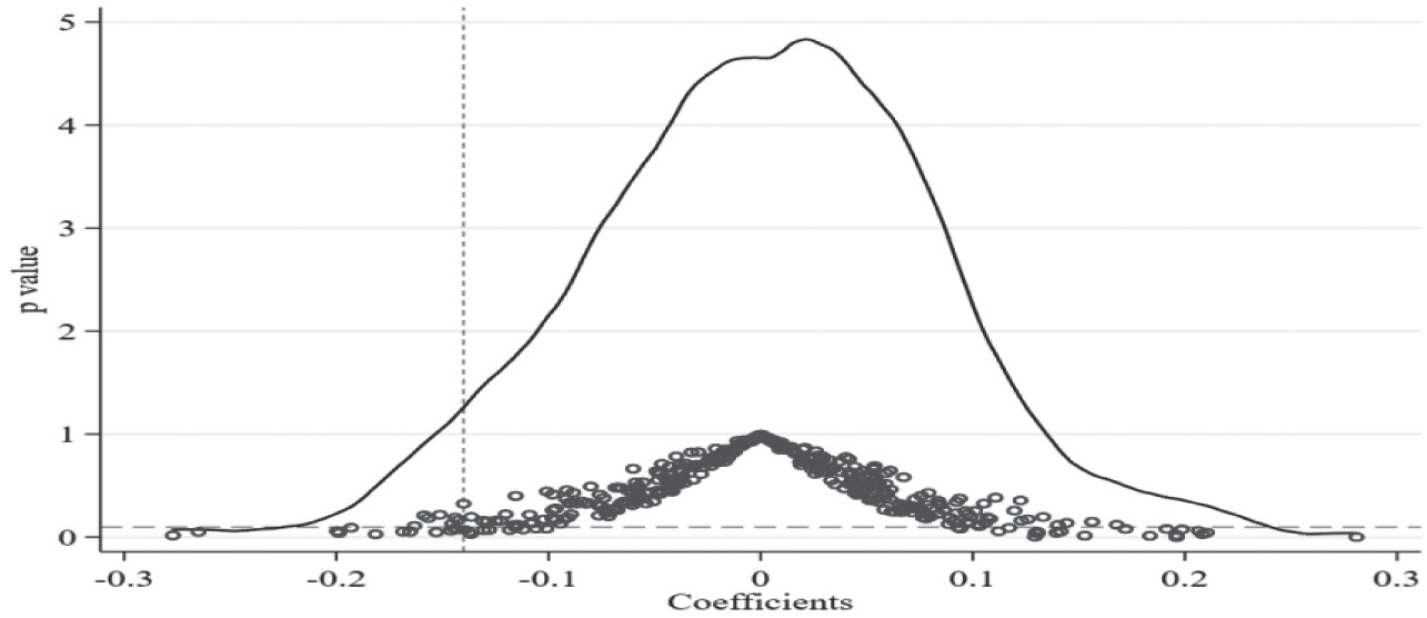
To determine whether the study results are influenced by variables such as year or other unobserved factors, this study refers to the studies of Polyakov et al. (2022) and Godsell et al. (2023) and conducts the placebo test by using a randomly fictitious treatment group [37, 38]. The specific procedure is as follows: Firstly, the policy year of the sample is randomly selected. Secondly, 102 samples are randomly chosen 500 times as the treatment group. Thirdly, pseudo-policy dummy variables are created for regression. If the regression coefficient of the pseudo-policy dummy variable is significant, it fails the placebo test; conversely, it passes the placebo test (see Fig. 1).
In Fig. 1, the dot represents the P-value of the regression coefficient of the pseudo-policy dummy variable, and the curve represents the kernel density distribution of the regression coefficient. From the kernel density curve, it can be observed that the estimated coefficients of the pseudo-policy variables are concentrated near 0, and the actual coefficient values are significantly outliers. Considering the P-value of the regression coefficient, most of them are above the significance level of 10%, indicating that the P-values of the estimated coefficients of the pseudo-policy variables are not significant. This indicates that the baseline regression results mentioned above are robust, and the construction of civilized cities in China is helpful to curb carbon emission intensity.
Robustness Test
To ensure the reliability of research conclusions, the robustness test is conducted using the propensity score matching (PSM) method and the replacement of explained variables method. The specific results are shown in Fig. 2 and Table 4.
The advantage of the PSM method is that it can match the control group with similar characteristics as the treatment group and effectively reduce the problem of sample self-selection bias [39]. Therefore, the nearest neighbor matching method is adopted to select the samples from the control group. Furthermore, the multi-period DID model is adopted to estimate policy effectiveness. As can be seen from Fig. 2, there is a significant difference in propensity scores between the treatment group and the (a) Before matching (b) After matching control group before matching. However, this difference decreased after matching, and the mean distance of propensity scores between the two groups was shortened. This indicates that the samples constructed by the PSM model are reasonable, and the DID model can be used to test the impact of civilized city construction on urban carbon emission intensity.
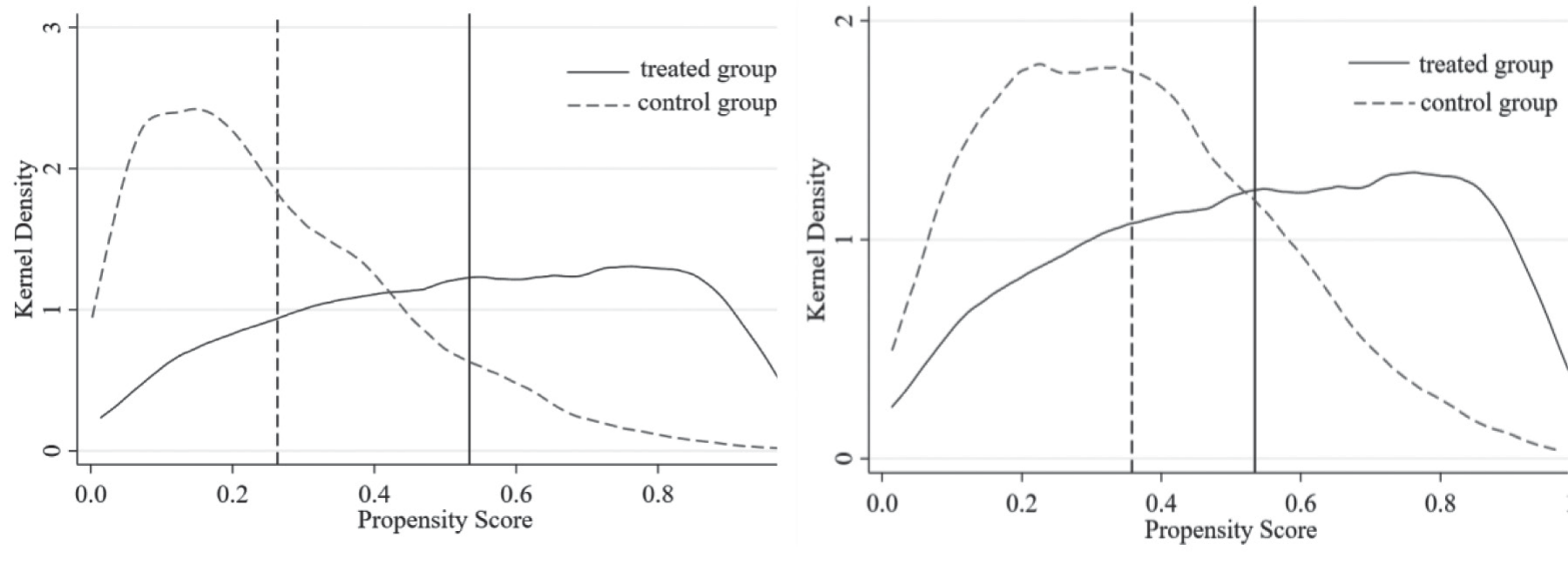
Table 4.
Robustness test results.
Firstly, the PSM-DIS model is used. Table 4 shows that the regression coefficients pass the significance test regardless of whether control variables are added. The regression coefficients are negatively correlated with carbon emission intensity and pass the significance test. This indicates that the construction of civilized cities in China contributes to suppressing urban carbon emission intensity, which is consistent with the baseline regression results mentioned above. This further confirms the robustness of the research results.
Secondly, the dependent variable is replaced. Following the study of Dehdar et al. (2022) [40], the logarithm of total carbon emissions is used as the dependent variable in the baseline regression to test the robustness of the results. Table 4 shows that the estimated coefficients in columns (3) and (4) are -0.096 and -0.080, respectively. The independent variable is negatively correlated with the dependent variable and passes the significance test at 10% and 5% levels, respectively. The results remain consistent and further support the robustness of the baseline regression results.
Mechanism and Heterogeneity Analysis of the Influence of Civilized City Construction on Carbon Emission Intensity
Mechanism Identification
The above results indicate that the construction of civilized cities in China effectively reduces carbon emission intensity. However, it is important to understand the mechanism behind this effect. To further explore the relationship between civilized city construction and carbon emission intensity, a mechanism test is conducted using formulas (2) and (3). The results are shown in Table 5.
Table 5.
Direct effects for the mechanism analysis.
From the mechanism test results of industrial structure, column (1) in Table 5 presents the regression results of the construction of civilized cities on the proportion of the secondary industry to GDP, with a regression coefficient of -2.717, which is significant at the 1% level. The column (3) represents the regression results of the construction of civilized cities on the proportion of the tertiary industry to GDP, with a regression coefficient of 0.974, also significant at the 1% level. These results indicate that the construction of civilized cities promotes the transformation of the industrial structure. This can be attributed to the pursuit of high-quality economic and social development as well as ecological and environmental improvement. In order to achieve these goals, it is necessary to eliminate outdated production capacity and accelerate the development of the service industry [41]. Columns (2) and (4) present the results of carbon emission intensity regression when considering both civilized city construction and the proportion of the secondary industry or the tertiary industry. Both estimated coefficients are significantly negative, indicating that civilized city construction reduces urban carbon emission intensity through adjustments in the industrial structure.
From the mechanism test results of energy consumption, column (5) shows that the regression coefficient between civilized city construction and energy consumption per unit of GDP is -0.102. This suggests that civilized city construction can contribute to a reduction in energy consumption per unit of GDP. In column (6), the estimated coefficient of the interaction term didnt is -0.086, and it passes the significance test at the 10% level. The regression coefficient of energy consumption per unit of GDP and carbon emission intensity is positive and significant at the level of 1%, indicating that the growth of energy consumption per unit of GDP will promote urban carbon emission intensity. In conclusion, it indicates that the construction of civilized cities can restrain urban carbon emission intensity by reducing energy consumption.
From the results of the mechanism test of technological innovation, column (7) indicates that the regression coefficient of the interaction term on the number of patent applications per capita is significantly positive. This shows that city pilots contribute to technological innovation. In fact, the construction of civilized cities in China has increased productivity and promoted the level of urban scientific and technological innovation [42]. In column (8), the regression coefficient of the interaction term is significantly negative at the 10% level. Specifically, the regression coefficient of the technological innovation variable on carbon emission intensity is significantly negative. This indicates that the construction of civilized cities can restrain urban carbon emission intensity through technological innovation and demonstrates the importance of technological progress in reducing CO2 emissions [43, 44].
Table 6.
Heterogeneity analysis results.
Heterogeneity Analysis
Due to significant differences in location, administrative level, and resource endowment among the cities involved in civilized city construction, these factors bring about different policy effects. However, academia has not yet analyzed this issue thoroughly. Consequently, this study aims to explore the heterogeneity of the impact of civilized city construction on urban carbon emission intensity from four dimensions, such as geographical location, city administrative level, city resource endowment, and city cultural and tourism resources. The specific findings are presented in Table 6.
Firstly, based on various location factors, the 277 prefecture-level cities can be categorized into eastern, central, and western cities. From Table 6, there is no significant impact of civilized city construction on urban carbon emission intensity in the eastern and western regions. However, it notably reduces urban carbon emission intensity in the central region. The estimated coefficient of the interaction term is -0.249 and is significant at the 1% level. The reason is that the eastern region has advantages in terms of industrial structure, technological innovation, and capital investment, which can help cities improve the utilization rate of clean energy [45]. On the other hand, after the large-scale development in the western region, it has taken over the industrial transfer from the eastern region, and the industrial structure is still dominated by secondary industry. Consequently, the marginal effect of civilized city construction on reducing urban carbon emission intensity in the eastern and western regions is not significant.
Secondly, provincial capitals are an important part of general prefecture-level cities. Compared with other prefecture-level cities, provincial capitals have advantages in terms of capital, technology, policies, and other aspects. Civilized city construction may have different impacts on carbon emission intensity among cities of different administrative levels. Therefore, this study divides the samples into sub-provincial cities, provincial capitals, and general prefecture-level cities. The benchmark regression results in Table 6 show a significant negative correlation between civilized city construction and carbon emission intensity in sub-provincial cities and provincial capital cities, while the impact on carbon emission intensity in general prefecture-level cities is not significant. The reason is that, compared to general prefecture-level cities, sub-provincial cities and provincial capital cities have higher levels of funding and policy implementation and therefore have higher requirements for environmental quality [46].
Thirdly, according to the difference in resource endowment, cities can be classified into resource-based cities and non-resource-based cities. The findings show that the construction of civilized cities significantly inhibits the carbon emission intensity of non-resource-based cities, while the impact on resource-based cities is not significant. This is consistent with the findings of Lee et al. (2022), indicating that low-carbon city pilot policies have an effect on reducing carbon emissions in resource-based cities [47]. The reason for this lies in the fact that resource-based cities rely on energy for long-term urban economic development, and it is challenging to optimize and adjust industrial structures in the short term.
Fourthly, cities can be classified as tourist cities and non-tourist cities, based on their cultural and tourism resources. As shown in Table 6, there is no significant effect on the carbon emission intensity of non-tourist cities. Mechanism tests indicate that civilized city construction inhibits urban carbon emission intensity by optimizing industrial structures. The optimization of the industrial structure refers to promoting the development of the tertiary industry in cities, while excellent cultural and tourism resources create prerequisites for the development of tourism. Additionally, tourist cities have a good ecological environment. Taking into account these factors, the construction of civilized cities can contribute to suppressing carbon emission intensity in tourist cities.
Conclusions
Based on the panel data of 277 cities in China from 2003 to 2019, this paper uses a multi-period DID model to assess the impact of civilized city construction on urban carbon emission intensity and examines the mechanisms behind this impact. The findings are as follows: Firstly, the construction of civilized cities helps to reduce urban carbon emission intensity, and the results are still valid after passing a series of robustness tests. The findings indicate that the construction of civilized cities reduces urban carbon emission intensity by 14.5%. Secondly, civilized cities reduce urban carbon emission intensity by adjusting the industrial structure, reducing energy consumption, and improving the level of scientific and technological innovation. Thirdly, civilized city construction has significantly different effects on urban carbon emissions intensity due to factors such as location, administrative level, resource endowment, and tourism resources. The heterogeneity test results demonstrate that: Among cities in different locations, civilized city construction has a significant inhibitory effect on the carbon emission intensity of cities in the central region, but has no significant effect on cities in the eastern and western regions. The carbon emission reduction effect of civilized city construction is more effective for cities in the process of industrialization. Among cities at different administrative levels, the construction of civilized cities significantly reduces the carbon emission intensity of sub-provincial cities and provincial capitals. Among cities with different resource endowments, civilized city construction has a significant inhibitory effect on carbon emissions intensity in non-resource cities, but the effect on reducing carbon emissions intensity in resource-based cities is not significant. Among cities with different cultural and tourism resources, the construction of civilized cities has a significant effect on the carbon reduction of tourist cities. Overall, this study provides evidence that the construction of civilized cities plays a positive role in reducing urban carbon emission intensity.
Based on the above research conclusions, in order to further promote the construction of civilized cities and promote urban energy conservation and carbon reduction, this paper tries to put forward the following suggestions:
(1) Summarize the positive effects and successful experiences of promoting civilized city construction on emission reduction. By accurately evaluating the carbon reduction effect of civilized cities, we can promote their construction and focus on exploring the successful experiences of pilot cities in emission reduction. These successful experiences can be implemented in other cities to drive policy initiatives for energy conservation and carbon reduction.
(2) Reduce urban carbon emission intensity from three aspects: optimizing industrial structure, reducing energy consumption, and improving technological level. First of all, adjusting the industrial structure in civilized cities can help reduce carbon emissions. This can be achieved by eliminating outdated production capacity and guiding the transformation and upgrading of energy-intensive industries. Additionally, providing policy support for the tertiary industry can create a favorable environment for its development. Secondly, civilized city construction can curb urban carbon emission intensity by reducing energy consumption per unit of GDP. Therefore, promoting a green lifestyle and enhancing residents’ awareness of environmental responsibility can reduce energy consumption. Meanwhile, increasing the use of clean energy, ensuring its supply, and improving infrastructure construction are also important. Lastly, improving the level of science and technology can help curb carbon emission intensity by increasing financial support for innovative technologies and protecting invention patents.
(3) Tailor policies to local conditions and make the national pilot program for civilized cities more scientific and targeted. Based on the heterogeneity test results, the pilot work of civilized cities has significant effects on reducing carbon emission intensity in central regions, higher administrative level cities, non-resource-based cities, and tourist cities. Therefore, cities with low carbon emission effects should be given attention in the future. Development plans should be formulated according to their development status, and civilized city construction and urban carbon reduction work should be promoted in an orderly manner.
This study finds that the construction of civilized cities can reduce urban carbon intensity, which has significant practical implications. However, there still exist some limitations. Firstly, due to data limitations, this study did not consider the sixth batch of civilized cities. Therefore, future research should dynamically focus on the construction of civilized cities to ensure more rigorous results. Secondly, enterprises are key players in achieving the “Carbon Peaking and Carbon Neutrality” targets. Therefore, future research should be refined at the enterprise level to ensure more accurate results. Thirdly, this study did not consider the impact of civilized city construction on the carbon intensity of neighboring cities. Therefore, future research should pay attention to the spatial spillover effects of civilized city construction to get more comprehensive results.

