

Introduction
Pakistan’s population is projected to grow at an annual rate of 2%, potentially doubling to 400 million in the near future. This rapid population growth poses a significant threat to food security [1]. Ensuring the country’s food security necessitates focusing on wheat production, which is a staple crop in Pakistan. Wheat is currently grown on 9.60 million hectares, yielding an annual production of 31.40 million tons [2]. As the primary food source for millions of people, maintaining and enhancing wheat production is critical for sustaining the country’s growing population. However, climate change poses a significant threat to wheat productivity due to increasing temperatures, erratic rainfall patterns, and frequent droughts. These climatic stresses can lead to reduced grain-filling duration, lower yields, and increased vulnerability to pests and diseases. Therefore, developing climate-resilient wheat varieties is essential to ensure stable production under changing environmental conditions [3-5].
Biofortification of staple crops with key micronutrients is an alternative strategy for reaching some of the country’s more remote areas, where food fortification coverage is impractical [6, 7]. This involves the enhancement of the nutrient content of the crop through traditional selective breeding techniques, genetic modification, and/or agronomic techniques, including the application of micronutrient fertilizers [8, 9]. Globally, several biofortified crop varieties have been released, including iron-rich pearl millet in India [10], zinc-rich rice in Bangladesh [11], and zinc-rich wheat in India and Pakistan [12]. The daily Zn requirement for the human body ranges from 8 to 13 mg [13]. Hence, zinc-biofortified wheat varieties can fulfill this daily intake without causing nutritional toxicity. However, zinc deficiency is associated with various health issues, such as impaired learning, weakened immunity, higher susceptibility to infections, and stunted physical growth.
Approximately 208 wheat varieties in Pakistan have been released, including five zinc-biofortified varieties. Among these, Nawab-21 and Akbar-19 from Punjab, along with Zincol-2016 from the National Agricultural Research Center (NARC), Islamabad, are recognized as zinc-biofortified wheat varieties. For the first time, the Agriculture Research Institute, Tarnab, Peshawar, has introduced two new high-yielding zinc-biofortified wheat varieties, namely, Tarnab Rehabar and Tarnab Gandum-I, in Khyber Pakhtunkhwa, reinforcing efforts toward wheat zinc biofortification.
Stripe rust (also known as yellow rust, YR) and leaf rust (LR), caused by Puccinia striiformis f. sp. Tritici (Pst) and P. triticina (Pt), respectively, can cause total crop loss when an early infection strikes in susceptible varieties. Annually, wheat rust pathogens contribute to global yield losses of approximately 15 million tons, equating to around US$2.9 billion, with yellow rust alone responsible for 5.5 million tons in losses [14, 15]. Durable rust resistance, characterized by race-nonspecific and long-lasting effectiveness, is crucial for sustained productivity [16]. YR generally occurs in cool and moist environments, whereas LR is more adapted to warmer environments coupled with ideal moisture conditions, but migrating and evolving YR races have infected wheat crops in previously unaffected areas [17, 18].
Wheat has three common rust resistance mechanisms: race-specific seedling/all-stage resistance, race-specific adult plant resistance (APR), and race-non-specific APR [19]. Race-specific resistance genes (R genes) offer relatively high resistance and are easier to select in breeding programs. However, these R genes are often overcome quickly by evolving rust races, especially when used singly, leading to “boom and bust” cycles. A total of 83 stripe rust (YR) and 80 leaf rust (LR) resistance genes have been cataloged in wheat [20, 21]. Most of these are R-genes, and many have already lost effectiveness due to pathogen virulence. Three pleiotropic APR genes – Lr34/Yr18/Sr57/Pm38/ Ltn1, Lr67/Yr46/Sr55/Pm46/Ltn3, and Lr46/Yr29/Sr58/ Pm39/Ltn2 – offer resistance to LR, YR, stem rust (SR), and powdery mildew (PM). The first two pleiotropic genes have already been cloned and characterized [22]. Combining 4-5 APR genes can result in near-immune rust resistance in CIMMYT wheat germplasm [23]. In light of the above, the present article aims to promote Tarnab Rehbar (TRB-2-103) as a high-yielding, zinc-biofortified, and rust-resistant wheat variety for irrigated and late sowing in Khyber Pakhtunkhwa.
Materials and Methods
Evolving History
The wheat line TRB-2-103 represents the outcome of a systematic and rigorous selection process conducted by the Cereal Research Program at the Agricultural Research Institute (ARI), Tarnab, Peshawar. Originally introduced by CIMMYT, Mexico, in 2017-18 as Entry No. 103 under the 38th Elite Spring Wheat Yield Trial (ESWYT), the line was designated TRB-2-103 for local testing and evaluation (Table 1). Its journey began with inclusion in the Preliminary Wheat Yield Trial during the 2017-18 cropping season at ARI, Tarnab. Among the 50 entries, including the check variety Pirsabak-15, TRB-2-103 exhibited outstanding yield performance by producing 6,692 kg/ha, 27.3% higher than the yield of the check cultivar (5,256 kg/ha). In addition to its superior productivity, the line showed strong resistance to yellow rust, with a terminal reaction of 0-TR. These results justified its advancement to the Regular B-Trial for further evaluation. In the 2018-19 Regular Wheat Yield Trial, a total of 26 promising lines, including TRB-2-103, were tested against two check varieties: Pirsabak-15 (PS-15) and Khaista-17. The line continued to demonstrate strong performance by yielding 13.80% and 10.8% more than PS-15 and Khaista-17, respectively. Its consistent superiority secured its progression to the provincial-level multi-location testing phase. During the 2019-20 season, TRB-2-103 was evaluated in the 8th Khyber Pakhtunkhwa Wheat Yield Trials (KPWYT), conducted across diverse agro-ecological locations under both normal/irrigated and late sowing conditions. Under normal/irrigated conditions at 14 different locations, TRB-2-103 achieved a mean yield of 3,233 kg/ ha, which was 6.3% and 0.09% higher than the general check cultivar Pirsabak-2013 (3,040 kg/ha) and the local check (3,230 kg/ha), respectively (Fig. 1). Similarly, under late sowing conditions at 10 locations, TRB-2- 103 maintained its performance by producing a mean grain yield of 2,586 kg/ha, outperforming Pirsabak-2013 (2,357 kg/ha) and the local check (2,364 kg/ha) by 9.7 and 9.3%, respectively (Fig. 2). This extensive and multi-stage evaluation underscores the genetic potential and adaptability of TRB-2-103 under diverse wheat-growing environments. Its consistent yield superiority and disease resistance position it as a promising candidate for strengthening regional wheat production.
Results and Discussion
National Uniform Wheat Yield Trials
NUWYT (Normal/Irrigated) 2020-21 and 2021-22 at Khyber Pakhtunkhwa
In NUWYT (normal) trials, the line TRB-2-103 was tested across 4 and 6 locations in Khyber Pakhtunkhwa during 2020-21 and 2021-22, respectively (Table 2). Averaged over two years, TRB-2-103 produced a grain yield of 5084 kg/ha, which was 7.40 and 9.70% higher than the general checks (Pakistan-13, Ghazi-19, Rustam-20, and Akbar-19) and local checks, respectively.
NUWYT (Normal/Irrigated) 2020-
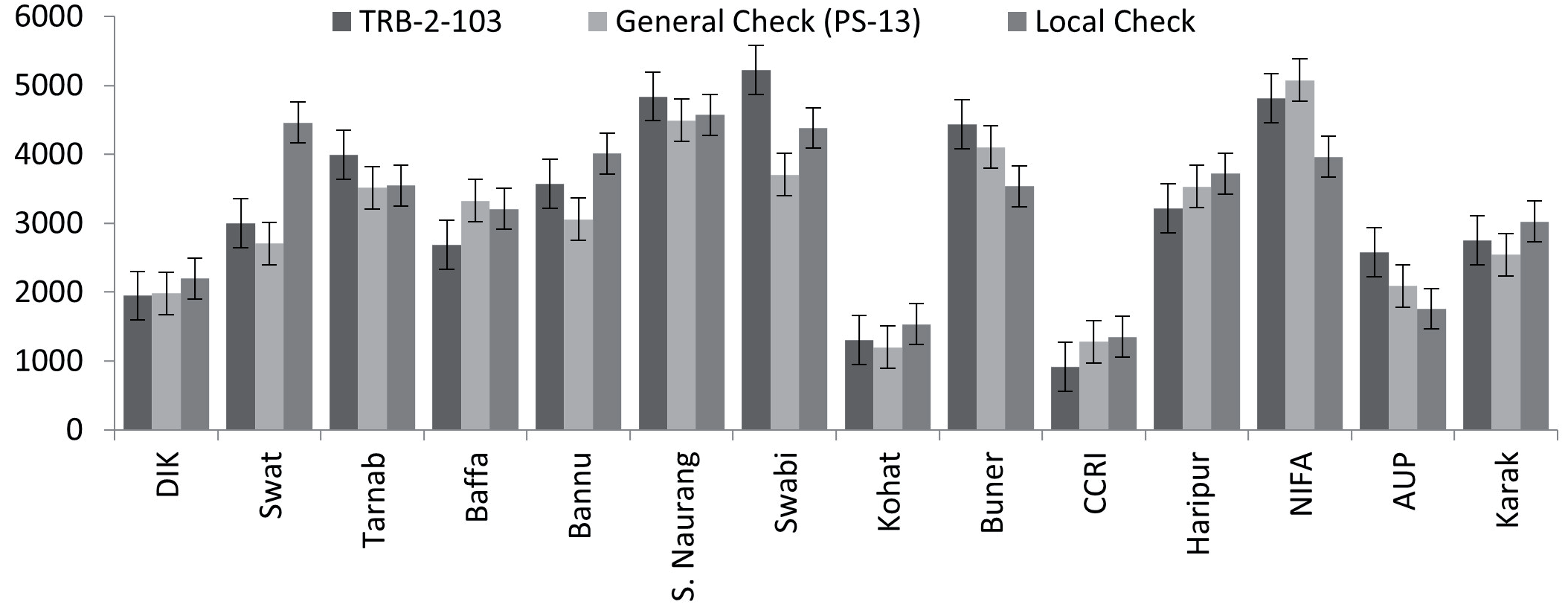
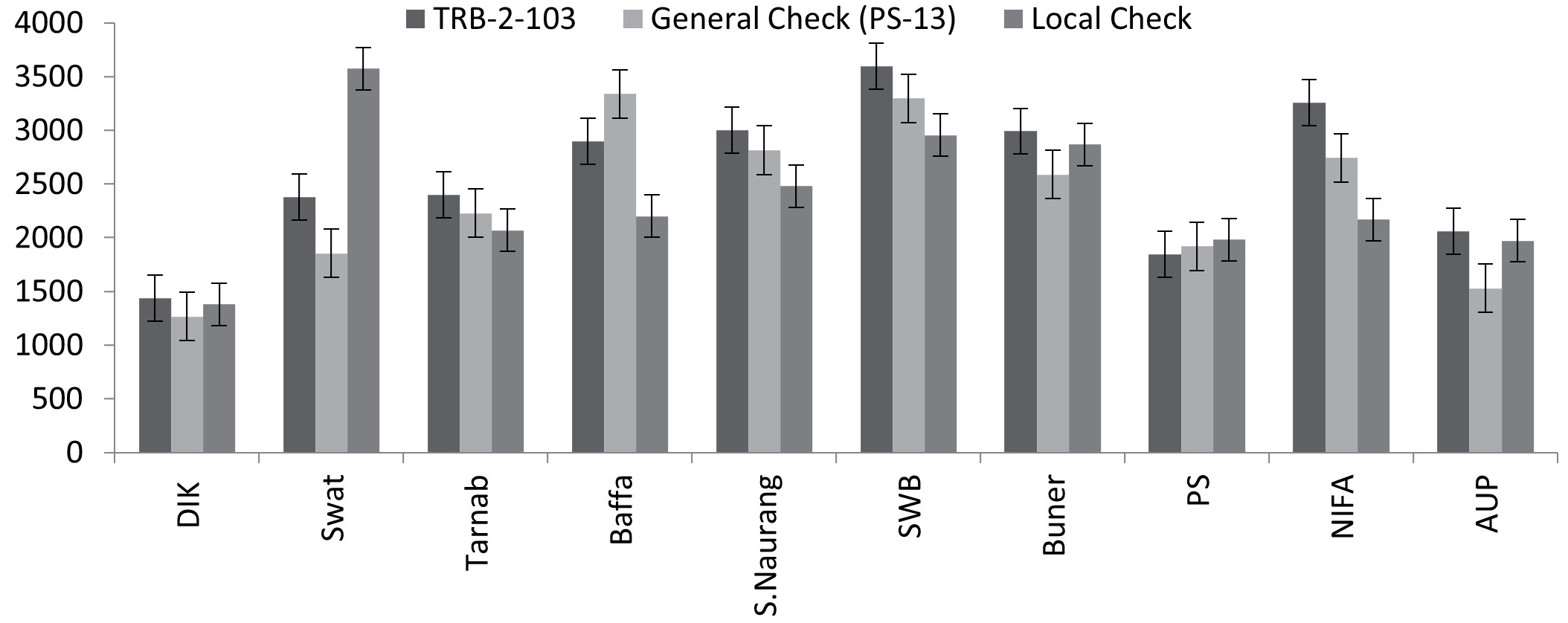
Table 2.
Grain Yield Performance of TRB-2-103 across two years (2020-21 and 2021-22) in NUWYT Irrigated in Khyber Pakhtunkhwa.
Table 3.
Grain Yield Performance of TRB-2-103 across two years (2020-21 and 2021-22) in NUWYT Irrigated in Pakistan.
21 and 2021-22 in Pakistan
To study the yield dynamics of the line TRB-2- 103 and its wider adaptability, it was tested at 31 and 40 locations across Pakistan during 2020-21 and 2021- 22, respectively (Table 3). Combined over two years across all locations, the line TRB-2-103 produced a grain yield of 4389 kg/ha and surpassed the general checks (Pakistan-13, Ghazi-19, Rustam-20, and Akbar-19) and local check varieties by 7.1 and 5.20%, respectively.
Agronomic Trials
Agronomic trials conducted at ARI, Tarnab, Peshawar, focused on optimizing planting time, fertilizer levels, and seed rate to achieve maximum grain yield. Sowing date trials revealed that October 20th was the most suitable time for planting Tarnab-Rehbar (TRB- 2-103), yielding 5477 kg/ha, while the lowest yield of 2400 kg/ha was recorded for the December 20th sowing. Fertilizer trials indicated that an NPK application of 120:90:60 kg/ha was optimal, resulting in a maximum yield of 6096 kg/ha. The study emphasized the genetic variability of wheat lines in nutrient utilization, underscoring the importance of tailored fertilizer strategies in variety development. Seed rate trials demonstrated that a seeding rate of 120 kg/ha produced the highest yield of 5937 kg/ha. These findings highlight the significance of agronomic optimization in enhancing yield potential.
Table 4.
The variety specific nucleotide barcode at the specified SNP positions using KASP markers.
Characteristics
Quality Characteristics
The proposed wheat line TRB-2-103 demonstrated strong performance in various quality traits. It exhibited a test weight of 71.80 kg/ha, a protein content of 15.4%, a starch content of 54.4%, and a gluten content of 30%. All these quality parameters align with Pakistan’s standard requirements.
Botanical Characteristics
Tarnab Rehbar exhibited a plant height of 95-105 cm, a dark green color at booting, and a stem diameter of 3-4 mm. It had a peduncle length of 12 cm and an average of 430 tillers per m2. The flag leaf measured 26 cm in length and 2.5 cm in width. The crop reached heading at 115 days, with a spike length of 12 cm and an awn length of 4-5 cm. The seeds were white, 6.5- 7.5 mm long, with a thousand-grain weight of 35 g. The genotype produced 55-60 seeds per spike, had a protein content of 15.40%, and yielded 6.7 tons per hectare.
Disease-Screening Studies
Present abiotic and biotic stress is attributed to the unusual yield loss in Australia and Pakistan, followed by India and China, while reducing effects for Canada, Russia, the USA, and Turkey [24]. The occurrence and extent of these losses may increase further due to changing climatic situations and hazards of a rust epidemic. Nearly half of the production losses were due to yellow rust in the previous disease epidemic [25]. Regarding the environment, the genetic diversity for the valuation of resistance could have been estimated by exploring disease severity and incidence parameters and the infection rate [26]. Both strategies were adopted to screen TRB-2-103 for yellow and leaf rusts at multiple locations, including the National Wheat Disease Screening Nursery during 2020-21 and 2021- 22 at CDRI, NARC, Islamabad. The average rust resistance index in TRB-2-103 for yellow and leaf rust was 7.95 and 8.26, respectively, during 2020-21 and 2021-22. The wheat line (TRB-2-103) demonstrated promising resistance to leaf rust (Puccinia triticina) during the 2021-22 cropping season, as detailed in the CDRI report (page 27, table 5). Evaluated across multiple environments, the line showed a coefficient of infection (CI) ranging from 0 in Faisalabad (immune) to 40 MSS in Bahawalpur, with other locations such as Karachi TMSS, Tandojam (5 MSS), Sakrand TMSS, Kunri TMSS, Thatta TMSS, and Multan (5 MSS) showing mild to moderate disease expression. These findings suggest that TRB-2-103 carries race-specific or adult plant resistance (APR) genes contributing to durable and broad-spectrum resistance. From a breeding perspective, such lines are vital for incorporating stable rust resistance into new cultivars, especially for rainfed regions like Khyber Pakhtunkhwa, where disease pressure can vary significantly. The overall resistance performance of TRB-2-103 highlights its potential as a parental line in future wheat improvement programs targeting both yield stability and rust resistance.
DNA Profiling
The Department of Plant Sciences at Quaid-i-Azam University, Islamabad, carried out DNA profiling of Tarnab Rehbar. Seeds were germinated under controlled conditions to facilitate DNA barcoding. Genomic DNA was isolated from 3-5 cm long seedling leaves grown in plastic trays filled with peat moss, following a two-Department of Plant Sciences Quaid-i-Azam University, Islamabad step CTAB extraction method described by [27-29]. The extracted DNA was assessed on a 1% agarose gel, ensuring a 50 ng µl⁻¹ concentration for subsequent SNP analysis.

SNP Genotyping
Single Nucleotide Polymorphism (SNP) genotyping was conducted using 32 carefully selected SNP markers from the 55K SNP array data, chosen for their effectiveness in distinguishing wheat cultivars [30, 31]. The genotyping process employed Kompetitive Allele Specific PCR (KASP) technology, a high-throughput platform widely used for analyzing key wheat traits. DNA samples were distributed into a 384-well clear plate using an automated SNPLine™ dispenser (LGC®, London, UK), air-dried at 55°C for 30 minutes, and mixed with KASP Master-Mix and specific primers. PCR amplification followed standard protocols, and fluorescence signals (FAM, HEX, and ROX) were detected at the Institute of Crop Sciences, Chinese Academy of Agricultural Sciences (CAAS), Haidian-Beijing, China. The genotyping results are presented in Table 4.
DNA Barcoding
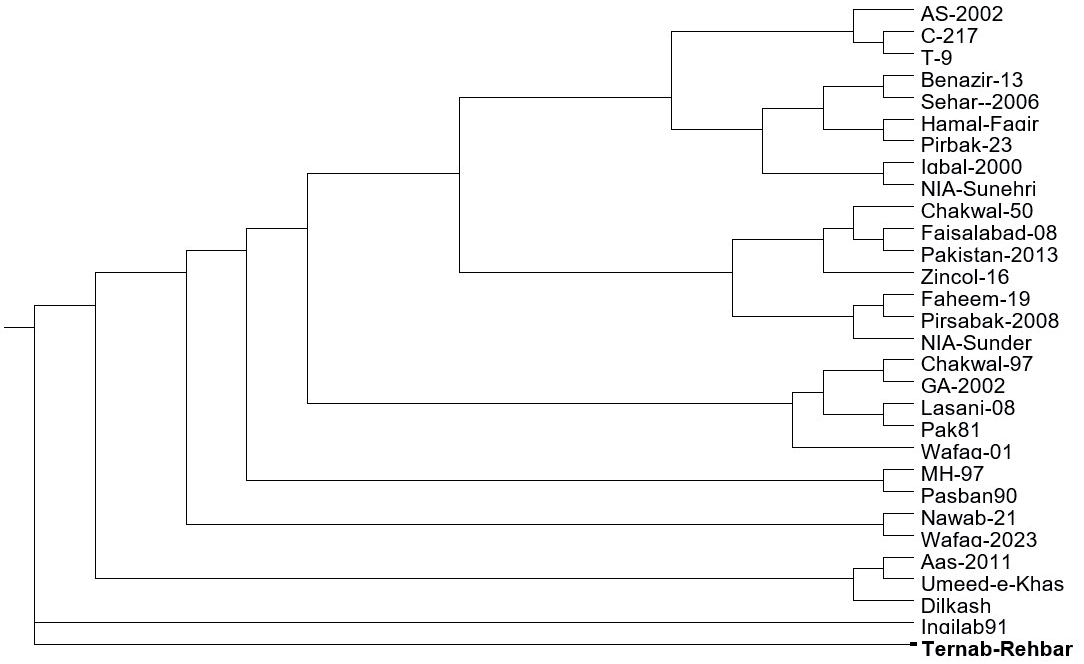
DNA barcodes were developed using polymorphism data from 32 SNP markers analyzed through KASP technology, following modified methods described by [32, 33]. Fig. 3 presents the dendrogram of Tarnab Rehbar, while Fig. 4 displays the 2-D barcode illustrating variety-specific nucleotides at the designated SNP positions identified by KASP markers. The nucleotide barcode of Tarnab Rehbar is distinct compared to 29 other Pakistani wheat cultivars, showing no similarity to any previously released varieties in the country.
Conclusions
Old and obsolete wheat varieties become vulnerable to biotic and abiotic stresses with prolonged field exposure. Replacing them with improved varieties enhances cost efficiency by utilizing additional genetic gains through wheat breeding. Tarnab Rehbar, a zinc-biofortified variety, was evaluated across multiple locations nationwide and demonstrated superior yield potential and resistance to yellow and leaf rust. Its biofortification helps combat malnutrition, while its reduced reliance on chemical inputs makes it a cost-effective and environmentally friendly option. Based on these attributes, Tarnab Rehbar was approved by the Provincial Seed Council for general cultivation in late and irrigated areas of Khyber Pakhtunkhwa, Pakistan, contributing to sustainable agriculture and national food security.

