

Introduction
Air pollution is a major environmental issue in China, with well-documented negative impacts on human health and socio-economic development [1-3]. In recent years, many local government officials in China have prioritized rapid economic growth over environmental protection, resulting in severe air pollution in numerous provinces [4]. According to the “2018 China Ecological Environment Status Report” released by the Ministry of Ecology and Environment, the extent of air pollution is alarming. In 2018 alone, 217 cities, representing 64.2% of all prefecture-level and higher cities, failed to meet air quality standards. The report further indicates that there were 1,899 days of severe air pollution and 822 days of heavy air pollution across these cities that year. Regional compound air pollution, involving pollutants such as ozone, fine particulate matter (PM2.5), and acid rain, has become increasingly common, leading to a rise in simultaneous air pollution events [5]. These pollution events have serious consequences, including increased respiratory illnesses, cardiovascular diseases, and premature mortality rates, as well as negative effects on agricultural productivity, biodiversity, and government stability [6, 7]. In response, the Chinese government has implemented various policies and initiatives to reduce air pollution, such as the Air Pollution Prevention and Control Action Plan and stricter emission standards for industries and vehicles. These efforts demonstrate a growing recognition of the urgent need to address air pollution and its extensive consequences for public health, environmental sustainability, and economic prosperity.
To combat severe air pollution, the Chinese government has introduced a range of environmental governance policies designed to strengthen atmospheric pollution control regulations and achieve various environmental, economic, and social benefits. To ensure compliance with environmental legislation at both local government and enterprise levels, provinces (including autonomous regions and municipalities) have established monitoring stations for fine particulate matter, with some stations under direct state control. Additionally, monthly air quality rankings are published for cities at the mainland level and higher within their administrative regions.
Fine particulate matter indicators in key regions and respirable particulate matter indicators in non-key regions are used as binding metrics for economic development. The fulfillment of the previous year's governance objectives is assessed at the beginning of each year. Authorities, including government officials and enterprise representatives, who fail to meet the required standards are held accountable annually. Moreover, the environmental impact of construction projects undertaken by enterprises is assessed, with project approval or rejection based on these evaluations.
By intensifying the supervision of environmental regulation implementation, local governments and enterprises are encouraged to collaborate to improve air quality.
In October 2012, the Chinese government launched the “Twelfth Five-Year Plan for Prevention and Control of Atmospheric Pollution in Key Regions,” targeting 47 cities in critical areas such as the Beijing-Tianjin-Hebei region, the Yangtze River Delta, and the Pearl River Delta. These regions, characterized by high economic activity and significant pollution emissions, face severe atmospheric environmental challenges. The comprehensive plan aimed to address air pollution through a variety of integrated approaches, including industrial optimization, clean energy utilization, pollution control, management innovation, project evaluation, and support measures. The implementation of this plan was crucial for achieving significant improvements in air quality in the designated key control regions.
Subsequently, in June 2018, the government introduced the “Three-Year Action Plan for Winning the Blue Sky Defense War,” which expanded to include 80 cities in key control regions such as the Beijing-Tianjin-Hebei region and surrounding areas, the Yangtze River Delta region, and the Fenwei Plain. This plan focuses on tackling air pollution through various measures, emphasizing industrial restructuring, energy transition, transportation optimization, land use adjustments, special actions, regional coordination, policy improvement, capacity building, and social engagement.
The recently released “2023 Action Plan for Continuous Improvement of Air Quality” expands the coverage of key prevention and control regions to 82 cities. This plan aims to comprehensively address air pollution through a variety of measures and strategies. These measures align with academic research and scholarly discourse, emphasizing the optimization of industrial and energy structures, the development of a green transportation system, the control of non-point source pollution, and the reduction of emission intensity. The plan also highlights the importance of institutional mechanisms, capacity building, law enforcement, and the integration of legal and regulatory frameworks with environmental and economic policies.
Given that the “2023 Action Plan for Continuous Improvement of Air Quality” has only recently been introduced, it is premature to evaluate the effectiveness of its implementation. Therefore, this study focuses primarily on the first batch of 47 cities in the key prevention and control regions and the second batch of 80 cities in key regions. The specific list of cities in these key prevention and control regions is provided in Table 1.
Some scholars argue that air pollution reduces the quality of accounting information, triggers agency problems, and diminishes firms' value, ultimately leading to a decline in enterprise value [8, 9]. Firms exposed to higher concentrations of air pollution may face increased risks of environmental violations, resulting in higher debt costs [10]. Air pollution not only directly impacts firm-level total factor productivity negatively but also reduces labor productivity, thereby affecting overall productivity [11]. Moreover, the severity of air pollution has been found to negatively influence a firm's investment efficiency, leading to lower innovation due to increased financial constraints and adverse effects on human capital [12]. Improving air quality can enhance firm value, reduce debt costs, increase total factor productivity, and stimulate corporate innovation, thus motivating firms to fulfill their environmental and social responsibilities in their operations.
Table 1.
Cities in the key prevention and control regions.
ESG refers to Environmental, Social, and Governance factors and was initially proposed as part of the United Nations Global Compact Programme in 2004. It encompasses a set of investment concepts and corporate evaluation standards that assess the environmental, social, and governance performance of companies rather than solely focusing on financial performance. Currently, ESG has become a pivotal indicator for evaluating corporate sustainability and is positively correlated with corporate performance. Investors increasingly prioritize ESG performance and demand it from companies [13, 14]. The concept of ESG aligns with the objectives of atmospheric pollution prevention and control policies as it integrates socio-economic development, environmental protection, corporate governance, and social responsibility.
Currently, most scholarly research on ESG primarily focuses on its economic effects. It has been observed that there is a negative correlation between a company's ESG performance and its financial risks. By improving ESG performance, companies can enhance their financial performance, reduce risk, increase enterprise value, and bolster their reputation [15, 16]. ESG performance has been found to significantly enhance a company's performance across different stages of its lifecycle, particularly during the growth stage [17]. Furthermore, ESG factors can positively impact the liquidity of listed companies by reducing agency costs, increasing foreign ownership, and improving corporate reputation [18]. Strong ESG performance also mitigates the risk of stock price collapse by curbing earnings management and corporate risk [19]. ESG performance influences investors' attitudes and subsequently affects their investment decisions [20]. Moreover, the size and independence of the board of directors have been found to have a positive impact on ESG disclosure, and strengthening corporate governance enhances ESG disclosure [21]. With the growth of the digital economy, the ESG performance of companies can be significantly improved through green innovation and digital transformation [22, 23].
To achieve sustainable development, it is essential for enterprises to adopt ESG practices. However, existing research predominantly focuses on the economic effects of ESG, with only limited exploration of the relationship between corporate ESG performance and atmospheric pollution control. China's A-share listed companies represent a significant component of the Chinese capital market and are subject to rigorous regulation by the China Securities Regulatory Commission. These companies are listed on the Shanghai and Shenzhen stock exchanges, with their shares traded in RMB, primarily for domestic investors in China. A-share companies encompass a diverse range of significant industries, including manufacturing, finance, information technology, and energy, and can be considered representative of Chinese listed companies.
In light of the aforementioned considerations, this paper regards the atmospheric pollution prevention and control policy as a prototypical quasi-natural experiment, reflects the ESG performance of A-share companies with the Huazheng ESG Rating Index, and explores the impact of this policy on the ESG performance of enterprises by employing the Difference-in-Differences (DID) causal identification method. The innovations in this paper are mainly: Firstly, it reveals the impact of atmospheric pollution prevention policies on corporate ESG performance using quasi-natural experiments in key prevention and control areas. Secondly, it enriches the literature on the factors influencing the ESG performance of listed companies by examining the impact of atmospheric pollution prevention policies. Thirdly, it provides useful insights for promoting enterprises to better practice ESG concepts and enhance their sustainable development capabilities.
Theoretical Analysis and Research Hypothesis
This section highlights several factors that demonstrate the relationship between atmospheric pollution control policies and corporate ESG performance.
Firstly, the accumulation of human capital is vital for the survival and growth of enterprises. Studies indicate that employees are more likely to leave companies located in cities with severe air pollution, particularly in industries that highly rely on talent. This talent drain has negative consequences for innovation within companies, which is a key driver of long-term economic growth [24, 25]. Therefore, effective atmospheric pollution control measures help retain talent, improve corporate social responsibility performance, foster green innovation, and ultimately enhance the overall ESG performance of companies.
Secondly, in terms of corporate transformation, worsening air pollution puts pressure on governments to prioritize environmental protection. This creates favorable conditions for green investments and corporate transformations. When air quality deteriorates, the constraints on accessing green finance decrease, and governments are more inclined to provide subsidies, reduce corporate tax burdens, and enhance the availability of environmental infrastructure [26, 27]. These measures facilitate corporate green transformation, thereby promoting improved ESG performance.
Lastly, enterprises exposed for their environmental pollution are more likely to attract attention from the media, the public, investors, and regulators, which can significantly impact their business operations. Atmospheric pollution control policies, as a form of environmental regulation, encourage enterprises to independently manage their pollution through market mechanisms. This increases enterprises' motivation to engage in environmental governance and attracts more investors, thereby promoting efforts to improve ESG performance [28]. Based on these factors, the following hypothesis is proposed:
H1: Atmospheric pollution prevention and control policies positively impact a company's ESG performance.
State-owned enterprises (SOEs) are enterprises owned and controlled, directly or indirectly, by the state or its representative bodies. These enterprises play an important role in the national economy and are usually involved in key industries and strategic sectors. They are directed and regulated in their operations and decisions by the government. On the other hand, non-state-owned enterprises are enterprises that are not owned by the state, such as private individuals, cooperative enterprises, foreign-invested enterprises, joint-stock companies, and collective enterprises. These enterprises are relatively independent in their operations and decision-making and are usually subject to market competition and relevant laws and regulations. Compared to non-SOEs, SOEs are more responsive and responsible in meeting policy requirements, actively following the environmental regulations proposed by the government to fulfill the government's goals and requirements [29]. Some scholars argue that despite the constraints imposed by state ownership, state-owned enterprises should exhibit greater responsibility towards public welfare compared to private firms. They propose that political connections can lead to increased environmental investments in state-owned enterprises, thereby surpassing non-state-owned enterprises in terms of pollution management [30, 31]. Based on this, to explore the heterogeneity of the impact of atmospheric pollution prevention and control policies on corporate ESG performance due to different ownership structures, this study proposes the following hypothesis:
H2: The impact of prevention and control of atmospheric pollution policies on the ESG performance of state-owned enterprises is better than that of non-state-owned enterprises.
Different industries exhibit varying degrees of impact on atmospheric pollution, leading to divergent reactions from companies when atmospheric pollution prevention policies are implemented. Consequently, there exist disparities in the environmental, social, and governance performance of companies. Enterprises operating in polluting industries are already obligated to disclose information related to the environment, giving them a stronger foundation for disclosure and potentially favorable ESG performance upon policy implementation. Research by Lin and Zhang [32] has demonstrated that the enforcement of environmental regulatory policies leads to a significant reduction in pollutant emission intensity within highly polluting industries, primarily through increased corporate investment in the environment. Compared to non-polluting industries, environmentally sensitive firms with enhanced overall ESG performance exhibit positive effects on profitability and contribute to an increase in market capitalization, as illustrated by Naeem et al. [33]. Hence, in order to examine the diverse effects of atmospheric pollution prevention and control policies on corporate ESG performance across industries, this study proposes the following hypothesis:
H3: The impact of atmospheric pollution prevention and control policies on the corporate ESG performance of highly polluting enterprises is better than that of non-highly polluting enterprises.
Methods
Research Design
The research steps undertaken in this paper are as follows:
Data Collection: Gather relevant data on Chinese A-share listed companies from 2009 to 2022 and clean the collected data to ensure accuracy and consistency.
Model Building: Construct a Difference-in-Differences (DID) model and set fixed effects and random error terms to analyze the impact of atmospheric pollution prevention and control policies on corporate ESG performance.
Variable Selection: Choose appropriate variables, including:
Independent Variables: Representing policy implementation.
Dependent Variables: Measuring firms' ESG performance.
Control Variables: Accounting for other factors that may affect firms' ESG performance.
Statistical Analysis: Conduct regression analysis using Stata and test the robustness of the regression results to ensure the reliability and validity of the findings.
Sample Selection and Data Sources
This study empirically analyzes Chinese A-share listed companies in Shanghai and Shenzhen from 2009 to 2022 to investigate the impact of atmospheric pollution prevention and control policies on their ESG performance. The evaluation of corporate ESG performance is conducted using the Huazheng ESG Rating Index, with data sourced from the Wind database and additional information obtained from the CSMAR database.
To ensure data quality, certain exclusions and data processing techniques are applied:
Samples from the finance, insurance, and real estate industries are excluded.
ST, *ST, and PT companies are omitted.
Companies with data anomalies or missing data are also excluded.
To mitigate the influence of extreme values, continuous variables are winsorized at the 1% and 99% quartiles. The resulting dataset comprises a total of 26,896 sample observations, representing 2,743 listed companies.
Research Model
The Difference-in-Differences (DID) model is widely used for its significant advantages in policy evaluation. Firstly, the DID model effectively controls for individual heterogeneity and time-invariant characteristics, enhancing the reliability of the results [34]. Secondly, it can clearly identify the actual impact of policies, particularly in the assessment of environmental and economic policies. Additionally, the DID model can reveal regional variations in policy effects, providing targeted improvement suggestions [35]. However, the DID model also has some limitations, including high complexity, large data requirements, and reliance on the parallel trends assumption, which can lead to estimation bias [36].
In this paper, A-share listed companies in cities included in the key prevention and control areas are designated as the treatment group, while A-share listed companies in cities not included in these areas are designated as the control group. By comparing the difference in changes in ESG scores between the treatment and control groups after the implementation of atmospheric pollution prevention policies, the impact of these environmental policies on companies' ESG performance is revealed.
Since the atmospheric pollution control policy was implemented in two batches, this paper employs the methodology proposed by [37] to conduct a comprehensive evaluation of the policy's impact on companies' ESG performance. The following econometric model is constructed to investigate the influence of atmospheric pollution control on companies' ESG performance:
In model (1), ESGi,t is the dependent variable, representing the ESG performance of company i at year t. Policyi,t is the independent variable, a dummy variable indicating whether the company is in a key prevention and control area. Controli,t represents a set of control variables, with φi representing firm-level fixed effects, γt representing time fixed effects, and εi,t being the error term.
Variable Definition
Dependent Variable
Company ESG performance. This study utilizes ESG ratings derived from China's Huazheng ESG Rating System to evaluate the environmental, social responsibility, and corporate governance performance of corporations. The Huazheng ESG Rating System incorporates internationally recognized methodologies and practical experience, combining the core concepts of international ESG with China's national conditions and capital market characteristics. It assesses listed companies across three dimensions: environment, society, and corporate governance, using public market information and official issuer documents.
The Huazheng ESG Rating System consists of three primary pillar indicators, 16 secondary subject indicators, 44 tertiary topic indicators, nearly 80 fourth-level underlying indicators, and more than 300 underlying data indicators. It integrates advanced technologies such as semantic analysis, natural language processing (NLP), and intelligent algorithms to construct an ESG big data platform that covers all A-share listed companies. The Huazheng ESG Rating is widely employed by investors and researchers of listed companies in Mainland China and Hong Kong.
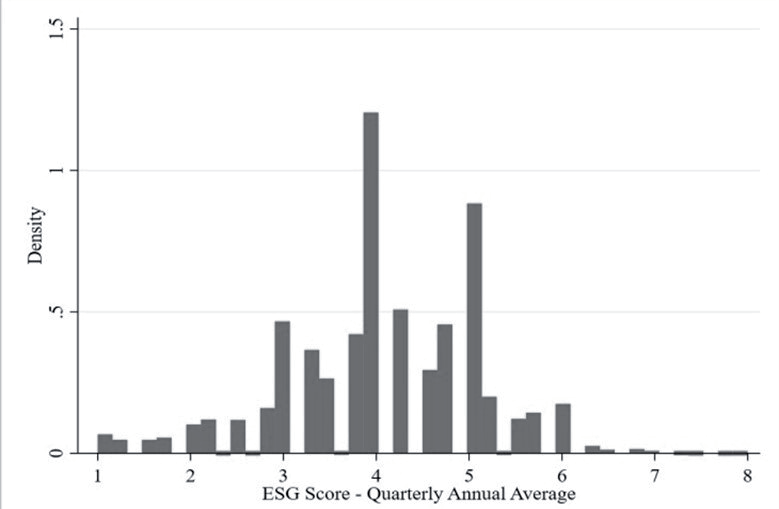
The ratings are categorized into nine grades, ranging from low to high: C, CC, CCC, B, BB, BBB, A, AA, and AAA. This paper adopts a nine-point system to assign scores to corporate ESG performance, where grades C to AAA correspond to scores of 1 to 9. A higher score indicates better performance in terms of environment, social responsibility, and corporate governance.
To measure annual ESG performance, the study uses enterprise-annual panel data and computes the average of the four quarterly scores for each year, based on the nine-point scale. Fig. 1 shows the ESG performance scores of the sample enterprises, indicating that most firms scored between 3 and 5 on ESG performance.
Independent Variable
Policy implementation. The variable Policyi,t is represented by an interaction term, which is obtained by multiplying a dummy variable indicating the key prevention and control regions with another dummy variable representing the year of policy implementation. To address the issue of overlapping key prevention and control regions in the two batches of lists, this study adopts the approach proposed by Wang et al. [38], which determines the earliest implementation time for policies in cities. If a city has multiple policy implementation times, the earliest time is selected.
The key regions for prevention and control were initially announced in October 2012. Following the methodology introduced by Li et al. [39] and accounting for the implementation lag, policies for the first batch of key regions were planned to be implemented in 2013.
To assign values to the interaction term, denoted as Policyi,t , the following criteria are observed: If a company's registered location falls within a key prevention and control region, and the year is the same as or later than the policy implementation year, Policyi,t is assigned a value of 1; otherwise, it is assigned a value of 0.
Summary of Criteria for Interaction Term:
Key Prevention and Control Region Dummy: Indicates whether a company is located in a key prevention and control region.
Year of Policy Implementation Dummy: Indicates the year of policy implementation, considering the earliest implementation time.
Interaction Term Policyi,t: • Assigned a value of 1 if the company's registered
location is within a key prevention and control
region and the year is the same as or later than
the policy implementation year.
• Assigned a value of 0 otherwise.
Control Variables
To mitigate potential bias in the estimated coefficients due to omitted variable problems, this study selects a series of indicators based on relevant literature [40-42]. The control variables include:
1. Firm Age (Age): Represented by the natural logarithm of the number of years listed plus one.
2. Firm Size (Size): Measured by the natural logarithm of total assets at year-end.
3. Firm Growth (Growth): Represented by the ratio of the difference between the current operating income and the previous operating income to the previous operating income.
4. Firm Value (TobinQ): Represented by the ratio of market value to total assets.
5. Financial Leverage Ratio (Lev): Expressed as the ratio of total liabilities to total assets.
6. Return on Net Assets (ROA): Determined by the ratio of net income to total assets.
Table 2.
Variables definition.
7. Percentage of the Top Shareholder's Shareholding (Top1): Measured as the shareholding ratio of the largest shareholder multiplied by 100.
8. State-owned Enterprise (SOE): Denoted as 1 if the firm is state-owned, otherwise 0.
9. Level of Industrial Structure (GDP2): Represented by the share of the secondary industry in GDP.
10. Level of Economic Development (lnGDP): Denoted by the natural logarithm of per capita GDP. Table 2. outlines the definitions of the variables.
Results and Discussion
Descriptive Statistics
The descriptive statistics of the variables used in this paper are presented in Table 3. The evaluation of ESG performance among enterprises is conducted using ESG scores, with a maximum value of 8 and a minimum value of 1. This range indicates notable differences in ESG performance among the sampled enterprises.
ESG Scores: The mean ESG score is 4.06, suggesting that the overall ESG performance of the sample enterprises is average, with considerable scope for improvement. The standard deviation of 1.05 indicates that the ESG scores of the sample enterprises are relatively concentrated, showing minimal variation. This homogeneity in ESG performance suggests that the majority of enterprises exhibit similar levels of ESG performance.
Policy Implementation: The policy implementation sample comprises 61.8% of all enterprises, indicating significant representativeness in the study. This substantial foundation allows for a thorough investigation of the impact of atmospheric pollution prevention policy on the ESG performance of enterprises.
These descriptive statistics provide an overview of the dataset and highlight the variables' distribution, which is crucial for understanding the context and potential implications of the analysis.
Baseline Regression Results
The results of the baseline regression are shown in Table 4.
Column (1) demonstrates the results of the regression on a double-fixed basis without adding control variables. The coefficient of the explanatory variable “Policy” on corporate ESG performance is estimated to be 0.044, and it is statistically significant at the 5% level, indicating a positive effect.
Column (2) reports the regression results after including all control variables in the analysis while still employing a fixed effects model. The results show that after the implementation of the policies, companies located in key pollution control regions experienced an average increase of 0.071 in their ESG scores, which is statistically significant at the 5% level. This suggests that the policy implementation led to an overall improvement of 1.75% in corporate ESG performance.
These findings indicate that the effects of policy implementation are considerable and that atmospheric pollution control policies have a clear and significant positive effect on the promotion of corporate ESG management. This aligns with the findings of [43]. The impact of the policy is not limited to individual firms but has a generalized positive effect on the sample group of firms, reflecting the important role environmental regulation plays in promoting improved corporate ESG management.
Table 3.
Descriptive statistics.
Table 4.
Baseline regression results.
| (1) | (2) | |
|---|---|---|
| Variables | ESG | ESG |
| Policy | 0.044** (0.022) | 0.071** (0.033) |
| Constant | 4.030*** (0.014) | -4.518*** (0.920) |
| Control | NO | YES |
| Year | YES | YES |
| Firm | YES | YES |
| Observations | 26,880 | 22,116 |
| R-squared | 0.583 | 0.622 |
From these results, we can conclude that the prevention and control of atmospheric pollution policies significantly improve the ESG performance of companies, providing support for H1 in this study.
Robustness Tests
Parallel Trend Test
The parallel trend test is a prerequisite for empirical analyses using the DID model to ensure that the change trends of the experimental group and the control group are similar prior to the implementation of the policies. Specifically, there should be no systematic difference in the trend of change in the ESG performance of the sample companies regardless of whether the city in which they are located is included in the control area or not. This paper conducts a parallel trend test by comparing the changes in corporate ESG performance of the experimental and control groups before and after the implementation of the prevention and control of atmospheric pollution policies.
To address the issue of multicollinearity, this study selected 2013 and 2018 as the time points and excluded the first period prior to the inclusion in the key control regions during the analysis. The parallel trend plot illustrating this exclusion is presented in Fig. 2. The results confirm that the trend of company change is basically the same whether the prevention and control of atmospheric pollution policies are implemented or not, indicating that the parallel trend hypothesis of this paper is verified and the DID model is applicable to the study of this paper.
The overall upward trend shown in the figure indicates that the prevention and control of atmospheric pollution policies improve the ESG performance of companies under certain other conditions. Moreover, the implementation effect strengthens over time, which further supports H1.
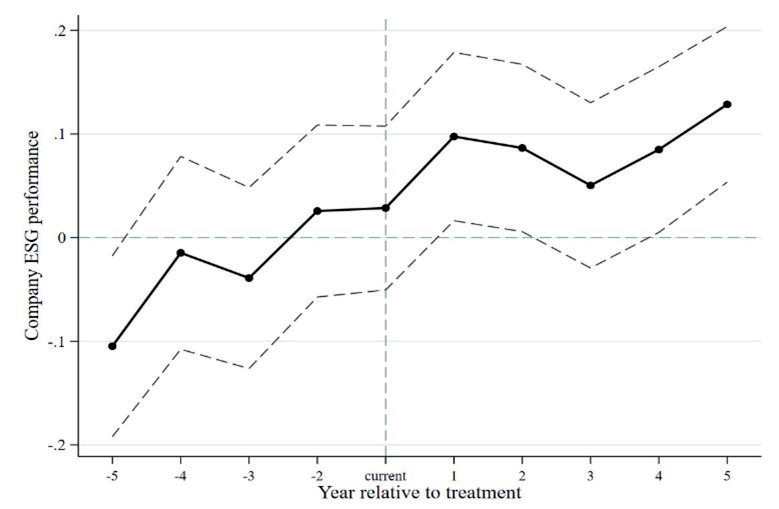
The figure depicts the trends in ESG performance for both the experimental and control groups over time, with key policy implementation points highlighted. The overall upward trend in ESG scores suggests that the policies have a positive impact on corporate ESG performance.
The results of the parallel trend test confirm that the DID model is suitable for this study. The verification of the parallel trend hypothesis indicates that the ESG performance trends of both the experimental and control groups were similar prior to the implementation of the policies. This allows us to attribute subsequent differences in ESG performance to the impact of atmospheric pollution prevention and control policies, supporting H1 that these policies significantly improve the ESG performance of companies.
Placebo Test
To determine whether the observed effects of atmospheric pollution control policies are specific to the actual policy implementation or may be influenced by other random factors, this paper conducts robustness tests by randomly sampling the interaction terms 500 times and comparing the resulting coefficients with the baseline estimates. This approach helps to confirm the validity and reliability of the findings.
Fig. 3 illustrates the kernel density and p-value distribution of the estimated coefficients from the 500 regressions. The analysis shows that 480 of the 500 randomly selected estimated coefficients for the interaction terms are not significant at the 5 percent level. This suggests that the effects observed in the baseline regression are not due to random chance or other unobservable factors, indicating that the placebo test passes.
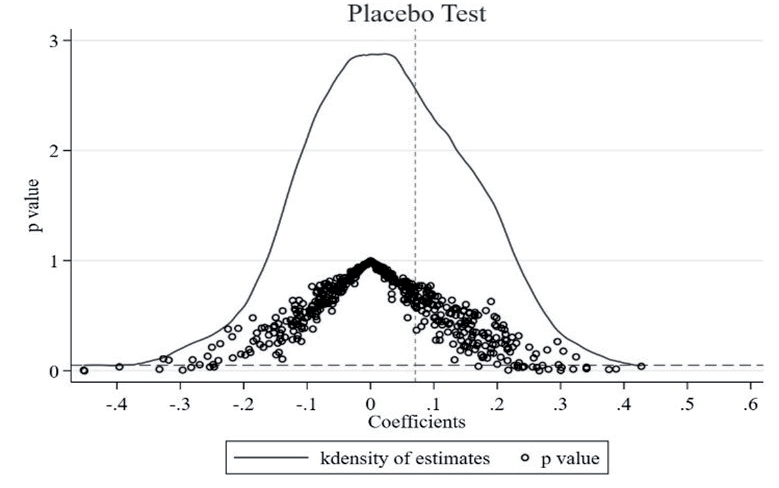
Table 5.
PSM-DID results.
| (1) | |
|---|---|
| Variables | ESG |
| Policy | 0.049* (0.026) |
| Constant | -4.356*** |
| Control | YES |
| Year | YES |
| Firm | YES |
| Observations | 21432 |
| R-squared | 0.627 |
The results of the robustness tests indicate that dummy policies do not have a significant effect on firms' ESG performance, further confirming the robustness of the baseline regression results. This supports the conclusion that the observed positive impact of atmospheric pollution control policies on ESG performance is robust and not influenced by other random or unobservable factors. These findings validate the hypothesis (H1) that atmospheric pollution prevention and control policies significantly improve the ESG performance of companies.
PSM-DID
The inclusion of a city in the list of key regions for the prevention and control of atmospheric pollution is not entirely random but is a decision made by the government following an inspection. To prevent selective bias from affecting the regression results, this paper employs the Propensity Score Matching-Difference-in-Differences (PSM-DID) method for further testing. Specifically, the 1:2 nearest-neighbor matching method is used to match the samples, and the Logit model is used to estimate the matching scores. The DID regression test is then conducted again.
The principle of the PSM-DID methodology is as follows:
Propensity Score Matching (PSM): The 1:2 nearest-neighbor matching method is employed to match treatment and control groups based on their propensity scores, which are estimated using a Logit model. This process helps to create a balanced sample where the treatment and control groups are comparable on observable characteristics.
Difference-in-Differences (DID): After matching, the DID regression is conducted again to estimate the impact of atmospheric pollution prevention and control policies on ESG performance while accounting for potential selection bias.
The regression results from the PSM-DID test, shown in Table 5, indicate that the estimated coefficient for the policy variable is significantly positive. This suggests that the estimation bias caused by selection bias in the sample selection process is not present. Therefore, the estimation results of this study are robust and reliable. The positive and significant coefficient further confirms that atmospheric pollution prevention and control policies have a significant positive impact on the ESG performance of companies, validating the robustness of the baseline regression results.
Replacement of the Dependent Variable Test
To address potential discrepancies resulting from variations in ESG performance among individual companies, this paper substitutes the company’s ESG score with the average ESG score of all companies in the city where the company is located for the regression analysis. The regression results are presented in Table 6, with City_ESG representing the average ESG score of city firms, employing fixed effects at the time, province, and city levels.
In Column (1), standard errors are clustered at the industry level, without the inclusion of control variables. The regression outcomes are significant at the 5% level.
In Column (2), control variables are included and continue to cluster standard errors at the industry level. The regression results are significant at the 1% level.
In Column (3), standard errors are clustered at the province level after incorporating control variables. The regression results are significant at the 10% level.
These results indicate that even after substituting the dependent variable with the city-level average ESG score, the influence of atmospheric pollution prevention and control policies on corporate ESG performance remains significantly positive. Specifically, policy implementation enhances corporate ESG scores by 0.0735, consistent with the baseline regression findings. Consequently, the regression results retain their significance when considering inter-firm variations, thus reinforcing the robustness of the paper's conclusions.
Heterogeneity Test
Heterogeneity Test of Enterprise Ownership
Due to direct or indirect state control, state-owned enterprises (SOEs) are more influenced by political factors. As a result, they tend to respond more swiftly to policy requirements and bear greater social responsibilities [29]. On the other hand, non-state-owned enterprises (non-SOEs) enjoy more decision-making independence and are less influenced by political factors. Consequently, when atmospheric pollution prevention and control policies are implemented, the extent to which these policies affect the two types of enterprises may vary.
Table 6.
Replacement of dependent variable regression results.
The analysis utilizes a dummy variable, “SOE”, to represent the state ownership attribute of listed companies. Specifically, when SOE=1, the listed company is classified as a state-owned enterprise, whereas it is considered a non-state-owned enterprise if SOE=0. Table 7 presents a comparative analysis of ESG performance between state-owned and non-state-owned enterprises under the prevention and control of atmospheric pollution policies.
According to the results presented in Column (1), the coefficient of the “Policy” variable for state-owned enterprises is higher than that for non-state-owned enterprises. Moreover, it is statistically significant at the 1% level, indicating a substantial improvement in the ESG performance of state-owned enterprises following the implementation of atmospheric pollution prevention and control policies. These findings align with the research conducted by Doshi et al. [44], which suggests a positive association between government ownership and ESG scores. Thus, the results of this study are consistent with the notion that state-owned enterprises, given their political and social attributes, demonstrate a greater willingness to engage in ESG practices. Conversely, non-state-owned enterprises are more inclined to adopt passive measures driven by relevant laws and regulations.
State-owned enterprises are typically subject to heightened expectations and more stringent requirements with regard to environmental regulation enforcement and ESG performance, given that they represent national interests. This encourages them to adopt a more proactive approach to investing resources and implementing effective measures to enhance their environmental performance. Furthermore, state-owned enterprises attach greater importance to social responsibility and corporate reputation. With enhanced financial and technical assistance, they are better positioned to fulfill environmental regulatory obligations and demonstrate superior ESG performance. Consequently, the prevention and control of atmospheric pollution policies exhibit significant variations in ESG performance across different types of ownership enterprises. Following policy implementation, state-owned enterprises outperform non-state-owned enterprises in terms of ESG performance.
Heterogeneity Test of Industries
Differences in the response of enterprises to atmospheric pollution prevention and control policies may arise based on their industry classification and product types. Industries with significant pollution potential, such as highly polluting enterprises, often face more stringent environmental regulations due to their substantial environmental impacts. Previous research by Lin and Zhang [32] has demonstrated that the implementation of environmental regulatory policies in highly polluting industries leads to a significant reduction in pollutant emission intensity. This reduction is achieved through increased corporate investments in environmental measures.
Following the approach of Ren et al. [45], this study classifies 16 industries, including thermal power, pharmaceuticals, and textiles, as highly polluting industries based on industry classification standards established by the former Ministry of Environmental Protection and the China Securities Regulatory Commission. These standards include the “List of Industry Classification Management for Environmental Protection Inspection of Listed Companies” and the “Guidelines for Industry Classification of Listed Companies”. The sample companies are then grouped based on whether they belong to heavily polluting industries, and the results are presented in Table 7, columns (3) and (4).
The results presented in column (3) show that the coefficient of the “Policy” variable for highly polluting enterprises is statistically significant at the 5% level, whereas the coefficient for non-highly polluting enterprises in column (4) is not significant. This indicates that the implementation of atmospheric pollution prevention and control policies has a more pronounced effect on highly polluting enterprises compared to non-highly polluting ones.
Table 7.
Replacement of dependent variable regression results.
Highly Polluting Enterprises
The significant positive coefficient suggests that atmospheric pollution prevention and control policies have brought more attention and stricter environmental regulatory pressure to highly polluting enterprises, compelling them to improve their environmental performance.
Investors' increasing attention to ESG performance also incentivizes these enterprises to enhance their ESG scores, promoting industrial transformation and upgrading.
Non-Highly Polluting Enterprises
The non-significant coefficient indicates that the ESG performance of non-highly polluting enterprises has not been significantly affected by the policies. This suggests that these enterprises may not yet fully recognize the importance of atmospheric pollution prevention policies.
There remains potential for improvement in ESG performance among non-highly polluting enterprises, as they have not yet taken these policies as seriously as highly polluting enterprises.
The findings reveal significant industry-specific differences in the impact of atmospheric pollution prevention and control policies on ESG performance across enterprises. The policies lead to a notable improvement in the ESG performance of highly polluting enterprises, while the impact on non-highly polluting enterprises is not significant. This underscores the importance of tailored regulatory approaches to enhance ESG performance across different industries.
Conclusions
This study employs a Difference-in-Differences (DID) model to examine the effects of atmospheric pollution prevention and control policies on the ESG performance of Chinese A-share listed companies from 2009 to 2022. By treating these policies as a quasi-natural experiment, the study empirically assesses their impact on the ESG performance of listed companies operating in key prevention and control areas. The findings reveal a significant positive effect of the implementation of atmospheric pollution prevention and control policies on the ESG performance of listed companies in these areas. Specifically, companies located in cities within the key prevention and control areas exhibit better ESG performance.
To ensure the robustness of the results, parallel trend tests, placebo tests, PSM-DID tests, and replacement of the dependent variable tests are conducted, which consistently support the main findings. Heterogeneity tests are also performed to explore the variations in the effects of the policies. The results indicate that state-owned enterprises, after the implementation of the atmospheric pollution prevention and control policies, demonstrate enhanced ESG performance, with a significant improvement compared to non-state-owned enterprises. Additionally, heterogeneity tests conducted on different industries suggest that the impact of the policies is more pronounced on highly polluting enterprises, resulting in a significant improvement in their ESG performance. Conversely, the effect on non-highly polluting enterprises is not significant.
Recommendations
Based on the findings of the study, this paper makes the following recommendations:
For the Government
1. Promote and Refine Policies: Continue to promote and deepen the policy of atmospheric pollution prevention and control, improve relevant laws and regulations, and establish a more detailed environmental regulatory system.
2. Encourage Sustainable Development: Encourage enterprises to develop the concept of sustainable operation, change their mode of development, and promote industrial upgrading and transformation while protecting the environment.
3. Support for Non-SOEs: Increase green financial policy support for non-state-owned enterprises to create favorable conditions for them to improve their ESG performance.
4. Strengthen Supervision of Polluting Industries: Continue to strengthen environmental supervision of highly polluting enterprises and advocate for their green transformation.
For Enterprises
1. State-Owned Enterprises: State-owned enterprises should continue to take the lead, actively participate in environmental governance, fulfill their social responsibilities, improve ESG working mechanisms, enhance ESG performance, and lead more enterprises to implement the new development concept.
2. Non-State-Owned Enterprises: Non-state-owned enterprises should also focus on improving their ESG performance to gain an advantage in future market competition.
3. All Enterprises: Both highly polluting and non-highly polluting enterprises should pay attention to their ESG performance to enhance their market competitiveness and contribute to green development.
Limitations and Future Research
This paper has several limitations:
1. Measurement of ESG Performance: It employs ESG scores to measure the environmental, social, and corporate governance performance of companies. However, ESG indicators encompass multiple aspects and involve various measurement methods, leading to inherent measurement errors in this approach.
2. Sample Scope: The sample is limited to A-share listed companies on the Shanghai and Shenzhen stock exchanges in China, without considering other listed companies. Consequently, the coverage of the study is constrained, and the applicability of the research findings is limited.
Future research could address these limitations by expanding the sample size and exploring the situation of other listed companies, thereby obtaining more comprehensive research results. Additionally, employing different methodologies to measure ESG performance could provide more nuanced insights into the relationship between pollution control policies and corporate ESG outcomes.

